Top Metrics to Track for AI Knowledge Base Performance
Anita
July 21, 2026
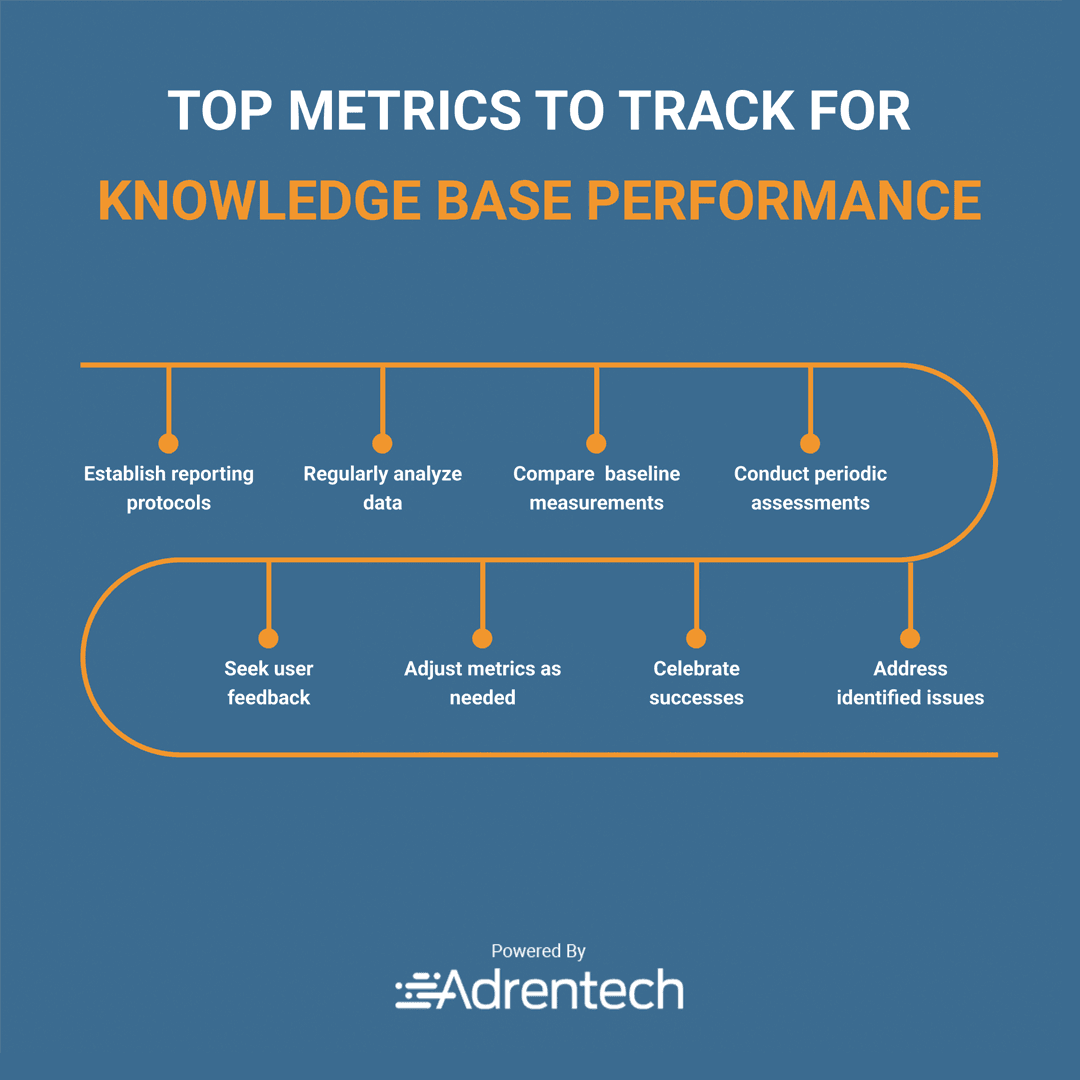
Top Metrics to Track for AI Knowledge Base Performance
An AI knowledge base can answer questions, surface relevant information, guide employees, and reduce repetitive support requests. But simply adding AI to a documentation library does not guarantee better results.
Organizations still need to measure whether people can find answers, whether those answers are accurate, and whether the system improves the overall customer experience.
The strongest performance framework combines established knowledge base metrics—such as page visits, failed searches, article helpfulness, contact rate, and content freshness—with newer measurements designed specifically for AI. These include answer acceptance, retrieval accuracy, escalation rate, citation quality, and the frequency of unsupported responses.
This guide explains the most important metrics for evaluating an AI-powered knowledge base, what each metric reveals, and how teams can turn the results into practical improvements.
Table of Contents
- Why AI Knowledge Base Performance Needs to Be Measured
- 1. Knowledge Base Adoption and Page Visits
- 2. Search Success Rate
- 3. Failed and Zero-Result Searches
- 4. AI Answer Acceptance Rate
- 5. Ticket Deflection Rate
- 6. Contact Rate Compared With Knowledge Base Usage
- 7. AI Answer Accuracy and Groundedness
- 8. Escalation and Human Handoff Rate
- 9. Most-Viewed and Most-Used Content
- 10. Article Helpfulness and User Feedback
- 11. Content Freshness and Update Age
- 12. Knowledge Gap Detection
- 13. Support Agent Knowledge Usage
- 14. Time to Answer and Resolution Speed
- 15. AI Cost per Resolved Inquiry
- How to Build an AI Knowledge Base Scorecard
- Frequently Asked Questions
Why AI Knowledge Base Performance Needs to Be Measured
A knowledge base is a centralized collection of information that customers, employees, or partners can search when they need help. In its simplest form, it contains documentation organized into categories and individual articles.
A traditional knowledge base largely depends on exact keywords, manually selected categories, and links between documents. The user enters a search term, reviews the available results, and decides which page is most likely to contain the answer.
An AI-based system changes that experience.
An AI knowledge base uses artificial intelligence, search technology, and language models to interpret the meaning behind a question. Rather than matching only the exact words entered in a query, it can retrieve information based on context and intent.
This is possible because AI that enables computers to process language can identify relationships between different phrases. Natural language processing, commonly shortened to NLP, helps computers to understand how people express the same need in different ways.
For example, the questions “How do I reset my password?” and “I cannot log in because I forgot my credentials” may require the same answer. An intelligent system can recognize this connection even though the wording is different.
Some platforms also use machine learning algorithms to rank results and improve recommendations based on data. More advanced tools incorporate generative AI to create a direct response from approved knowledge base content.
These capabilities make the experience faster, but they also create new measurement challenges. Page views alone cannot show whether an AI model interpreted a question correctly or whether the generated response was supported by a reliable source.
Teams therefore need metrics that evaluate both the documentation and the AI system using it.
1. Knowledge Base Adoption and Page Visits
The first metric to track is usage.
Measure how many customers, employees, or partners access the knowledge base each day, week, and month. Depending on the purpose of the platform, useful adoption measurements may include:
- Unique visitors.
- Returning visitors.
- Sessions per user.
- Pages viewed per session.
- Searches per session.
- Percentage of active customers using self-service.
- Percentage of employees using the internal knowledge base.
Page visits provide a basic indication of whether users know the resource exists and can access the knowledge base without unnecessary friction.
A low number of visits does not always mean that the content is poor. The platform may simply be difficult to find. Links might be missing from the website, application menu, support form, chatbot, or employee workspace.
Adoption should therefore be reviewed alongside discoverability. The best content provides little value when people cannot reach it.
For an internal knowledge solution, consider measuring adoption by department, role, or location. This can reveal whether one team has successfully adopted the platform while another continues to rely on direct messages, shared folders, or informal knowledge sharing.
2. Search Success Rate
Search success rate measures the percentage of searches that lead to a meaningful result.
A simple version of the calculation is:
Search success rate = Successful searches ÷ Total searches × 100
Defining a “successful” search requires some thought. A search could be considered successful when the user:
- Opens a result.
- Stays on the selected page long enough to read it.
- Marks the answer as helpful.
- Does not immediately repeat the query.
- Does not contact the support team afterward.
- Accepts an AI-generated answer.
In an AI-powered search experience, the definition may also include situations in which the platform produces an answer directly without requiring the user to open an article.
This metric is particularly important because AI knowledge bases work by interpreting intent, retrieving relevant content, and presenting it in a usable form. A high search success rate suggests that the platform understands user language and connects questions to the correct sources.
A low rate may indicate weak metadata, incomplete knowledge base content, poor indexing, inaccurate permissions, or problems with the retrieval configuration.
3. Failed and Zero-Result Searches
Failed searches show what users wanted to find but could not.
In conventional knowledge bases, this often means the search engine returned no matching documents. In an AI-driven knowledge base, a failed search may have several forms:
- No answer was returned.
- The response was unrelated to the question.
- The user repeated the search using different wording.
- The system returned an unsupported answer.
- The user opened several results but did not engage with any of them.
- The conversation was transferred to a human immediately afterward.
Review both the total number of failed searches and the exact phrases people entered. Those phrases provide a direct view of unmet needs and emerging knowledge gaps.
They may also reveal a language mismatch. Internal teams often describe products and processes differently from customers. A company might use an official feature name within the knowledge base while customers search using a simpler phrase.
Natural language processing can reduce this problem, but it cannot compensate for missing or badly structured information. AI still needs a strong source of truth.
Group similar failed searches by intent rather than reviewing each phrase separately. Twenty differently worded customer queries may all point to one missing article.
4. AI Answer Acceptance Rate
Answer acceptance rate measures how often users accept or positively engage with a response created by AI.
Possible positive signals include:
- Selecting “This answered my question.”
- Ending the session without another search.
- Clicking a recommended next step.
- Completing a process after receiving the answer.
- Avoiding a human escalation.
- Sharing or copying the response.
- Opening one of the cited sources.
The calculation can be expressed as:
AI answer acceptance rate = Accepted AI answers ÷ Total AI answers × 100
This is one of the most useful metrics for an AI-driven knowledge experience because it evaluates whether generated or summarized answers are genuinely useful.
Do not treat silence as automatic success. A user may abandon the interaction because the answer is confusing. Combine behavioral indicators with explicit user feedback wherever possible.
It is also helpful to segment acceptance rate by topic. An AI model may perform well for common questions such as password resets but struggle with complex billing policies or technical troubleshooting.
5. Ticket Deflection Rate
Ticket deflection estimates how many support requests were avoided because users found an answer through self-service.
A common formula is:
Estimated deflection rate = Self-service sessions without contact ÷ Total self-service sessions × 100
This metric is useful, but it should be interpreted carefully. Not every visit would otherwise have become a support ticket. Some users browse documentation to learn about a feature rather than solve an urgent problem.
A stronger approach is to analyze specific user interactions. Track whether someone searched for help, viewed an answer, and then opened a support conversation within a defined period.
For AI interactions, you can measure the percentage of conversations resolved without human involvement. This creates a more direct view of how an AI-powered knowledge base affects workload.
Deflection should never be optimized at the expense of service quality. Preventing users from reaching support is not the same as helping them.
The real goal is successful self-service.
6. Contact Rate Compared With Knowledge Base Usage
Contact rate measures the percentage of active customers who contact support during a specific period.
Contact rate = Customers contacting support ÷ Active customers × 100
Track this alongside knowledge base adoption. When self-service usage rises while the contact rate falls, the documentation may be helping customers resolve more problems independently.
Help Scout recommends examining the relationship between knowledge base traffic and customer contact volume rather than reviewing either number in isolation. Comparing support volume before and after publishing or updating content can also help show its operational impact.
Be cautious about assuming causation. A declining contact rate may also result from product improvements, seasonal changes, fewer incidents, or a different customer mix.
Use control periods or topic-level analysis where possible. For example, compare the number of billing-related tickets before and after publishing a new billing guide.
7. AI Answer Accuracy and Groundedness
An answer can sound confident and still be wrong.
Accuracy measures whether the response correctly answers the user’s question. Groundedness measures whether the response is supported by approved information within the knowledge base.
This distinction matters because a system that uses generative AI may produce fluent sentences that are not directly supported by available content.
A practical quality review should ask:
- Did the AI understand the question?
- Did it retrieve the correct source?
- Was the final answer factually accurate?
- Did the response omit an important limitation?
- Were the citations relevant?
- Did the system invent a policy, step, or product capability?
- Was the information current?
- Did the answer respect user permissions?
Teams can evaluate a sample of responses manually or use a separate evaluation workflow. The most reliable programs combine automated scoring with human review.
Segment accuracy by category and level of risk. A small error in a general product overview is not equivalent to an incorrect answer about account security, legal requirements, payments, or service eligibility.
The right AI knowledge base should make unsupported answers visible rather than hiding uncertainty behind polished language.
8. Escalation and Human Handoff Rate
Handoff rate measures how frequently an AI interaction is transferred to support agents.
Handoff rate = AI conversations escalated to humans ÷ Total AI conversations × 100
A high escalation rate is not automatically bad. Some issues require judgment, authorization, empathy, or account-specific action.
The metric becomes useful when it is segmented by escalation reason:
- Missing information.
- Low AI confidence.
- Customer requested a person.
- Authentication required.
- Policy exception.
- Technical failure.
- Negative sentiment.
- Unsupported transaction.
- Repeated unsuccessful searches.
This helps teams distinguish appropriate escalations from preventable ones.
For example, an escalation caused by a refund authorization may be expected. An escalation caused by a missing setup instruction suggests the customer knowledge base should be improved.
Track what happens after the handoff as well. The conversation should transfer the question, attempted answers, viewed articles, and other relevant context. Otherwise, the customer has to repeat everything.
9. Most-Viewed and Most-Used Content
The most frequently viewed knowledge base articles reveal which topics matter most to users.
High traffic can indicate:
- A common customer need.
- A confusing feature.
- A recurring product problem.
- Strong search visibility.
- A frequently shared article.
- An important onboarding step.
However, popularity is not always a sign of success. An article may receive many visits because the product experience is unclear or because users repeatedly return without resolving the issue.
Compare page traffic with helpfulness, contact rate, search reformulation, and time spent on the page.
An extremely long article that receives heavy traffic may also need to be divided into smaller, more focused pages. This can make relevant information easier to retrieve for both people and AI.
For an AI knowledge base, measure not only page views but also retrieval frequency. An article may rarely be opened by users while still being used thousands of times as a source for AI-generated answers.
That makes retrieval data essential for understanding the true value of knowledge base articles.
10. Article Helpfulness and User Feedback
Most knowledge base software allows readers to rate an article using a simple question such as “Was this helpful?”
Measure:
- Positive rating percentage.
- Negative rating percentage.
- Feedback response rate.
- Average score by article.
- Changes after content updates.
- Common themes in written comments.
Explicit ratings provide valuable user feedback, but they should not be treated as the only measure of quality. Response rates are often low, and dissatisfied users may be more likely to submit feedback.
Combine ratings with behavioral evidence.
For example, an article may have a strong helpfulness score but still generate many support contacts. This could mean the content is useful for some users while failing to cover an important scenario.
Written feedback is especially valuable. Classify comments based on customer feedback into themes such as unclear instructions, outdated screenshots, missing steps, technical errors, or requests for examples.
An AI system can help teams group large volumes of comments, but final editorial decisions should remain grounded in the actual responses.
11. Content Freshness and Update Age
Outdated content damages trust and can cause both customers and AI to provide or follow incorrect instructions.
Track:
- Average age of the last update.
- Percentage of content reviewed within the last quarter.
- Percentage of expired articles.
- Number of pages without an assigned owner.
- Time between a product change and a documentation update.
- Frequency of AI answers using outdated sources.
Help Scout recommends monitoring the average age of the last update and regularly reviewing both internal and external knowledge bases. It also suggests using expiration periods that require an owner to verify or update an article.
Not every page needs the same review frequency. A password-reset guide may need to be checked after every authentication change, while a general company-history article may remain accurate for years.
Create review schedules based on risk and change frequency.
An AI knowledge management platform should also prevent expired or unapproved material from being used in generated answers. Otherwise, advanced AI simply distributes outdated information faster.
To keep the knowledge base trustworthy, ownership must be clear. Every critical article should have an author, reviewer, next review date, and defined source.
12. Knowledge Gap Detection
Knowledge gaps are questions that the current documentation cannot answer adequately.
They can be identified through:
- Failed searches.
- Low-confidence AI responses.
- Repeated query reformulation.
- Human escalations.
- Support ticket topics without matching content.
- Negative article feedback.
- Agent requests for new documentation.
- Frequently used unofficial documents.
- Answers assembled from several incomplete pages.
An automated inquiry generator or analytics workflow can group unanswered questions by topic and estimate how many users are affected.
Prioritize gaps using more than volume. A rare compliance question may be more important than a frequently asked low-risk question.
A useful prioritization model considers:
Priority = Frequency × Business impact × User effort × Risk
The strongest AI knowledge base software does not merely search existing material. It shows teams where content is missing, weak, contradictory, or difficult to retrieve.
Some systems can automatically generate a first draft based on customer interactions or approved documents. That can streamline content creation, but generated drafts still need human review before publication.
13. Support Agent Knowledge Usage
An external help center is only one part of the knowledge ecosystem. The same content can also help a support team deliver faster, more consistent answers.
Track how frequently support agents:
- Search the internal knowledge base.
- Open recommended articles.
- Insert knowledge links into replies.
- Accept AI-recommended responses.
- Edit AI-generated suggestions.
- Ignore recommendations.
- Flag inaccurate content.
- Request new documentation.
Help Scout identifies the use of help documents in support replies as an important metric. Frequent usage may reflect growing confidence in the quality and coverage of the documentation.
Low usage can have several causes. Agents may not trust the content, search may be slow, the platform may sit outside their regular workflow, or the articles may not address real conversations.
Integrate the knowledge base platform into the agent workspace whenever possible. Contextual recommendations are more likely to be used than a separate system requiring additional searching.
An AI-powered knowledge management layer can analyze the current conversation, identify intent, and retrieve the right internal knowledge automatically. This helps agents respond without switching between multiple tools.
The goal is not to replace judgment. It is to give people faster access to consistent, approved information.
14. Time to Answer and Resolution Speed
Measure how long it takes users to receive a usable answer.
For customer self-service, this may include:
- Time from the first query to the accepted answer.
- Number of searches before resolution.
- Number of articles opened.
- Time spent navigating between pages.
- Time before requesting human help.
For internal users, measure:
- Time spent searching before opening the correct document.
- Time between a question and an agent response.
- Average handling time for conversations using AI assistance.
- Resolution time with and without knowledge recommendations.
An AI knowledge base with AI retrieval should reduce the time needed to locate relevant content. However, speed is only valuable when the response is correct.
A fast but inaccurate answer can create more work later.
Track speed alongside answer accuracy, customer satisfaction, repeat contacts, and escalation rate. This prevents teams from optimizing one attractive number while weakening the broader experience.
15. AI Cost per Resolved Inquiry
AI introduces infrastructure and usage costs that do not exist in exactly the same form within conventional knowledge bases.
Depending on the system, costs may include:
- AI model usage.
- Search and retrieval infrastructure.
- Content processing.
- Vector storage.
- Third-party integrations.
- Monitoring and evaluation.
- Human review.
- Platform licensing.
Calculate:
AI cost per resolved inquiry = Total AI operating cost ÷ Inquiries resolved successfully by AI
You can also compare this with the estimated cost of a human-assisted conversation.
Cost should not be evaluated independently from quality. A cheaper model that creates more errors, escalations, and repeat contacts may ultimately cost more.
The objective is not simply to use AI at the lowest possible price. It is to apply the power of AI where it improves access, reduces effort, and creates a sustainable return.
Additional Metrics for an Internal Knowledge Base
An internal knowledge base may require a slightly different scorecard from a public customer knowledge base.
Useful internal metrics include:
- Employee adoption by department.
- Repeat searches for the same process.
- Time required to locate policies.
- New employee onboarding time.
- Duplicate document rate.
- Percentage of documents with confirmed owners.
- Internal answer accuracy.
- Permission-related search failures.
- Reduction in questions posted to subject-matter experts.
- Contribution rate across departments.
Internal knowledge sharing often fails when information is scattered across messages, local files, outdated documents, and individual experience.
A well-maintained platform creates a single source of truth, but only when employees trust it. If users continue asking colleagues instead of using knowledge base search, the system may not yet be reliable enough.
Measure the use of unofficial channels as a secondary signal. A decline in repeated internal questions may indicate that AI-based knowledge access is becoming more effective.
How AI Knowledge Bases Work
To choose meaningful metrics, it helps to understand the basic process behind an intelligent response.
Most systems follow a sequence similar to this:
- A user submits a question in human language.
- NLP or another language-processing method identifies the likely intent.
- The system converts the question into a representation that can be compared with indexed content.
- Relevant sections are retrieved from the knowledge base.
- An AI model ranks, summarizes, or combines the available information.
- The system generates a response.
- The answer may include links or citations to its sources.
- User interactions are recorded for later analysis.
In some cases, ML algorithms learn from data such as clicks, accepted answers, corrections, and escalations. These patterns may help improve ranking or recommendations.
Artificial intelligence can also personalize results based on role, account type, location, product, or previous activity. Any personalized responses based on customer data must follow appropriate privacy, security, and permission rules.
The AI can only be as reliable as the content and controls supporting it. Poor source material makes AI less useful, regardless of how advanced the AI capabilities appear.
Traditional Knowledge Bases vs. AI-Powered Knowledge Bases
Unlike traditional knowledge bases, AI-powered platforms can interpret questions that do not exactly match article titles or keywords.
Conventional knowledge bases usually return a list of documents. AI can also synthesize a direct answer, recommend next steps, or continue the interaction in a conversational format.
This creates several benefits:
- Faster access to answers.
- Better handling of natural questions.
- More relevant search results.
- Personalized guidance.
- Reduced navigation.
- Automated identification of content gaps.
- Stronger internal knowledge sharing.
It also creates additional risks:
- Unsupported responses.
- Incorrect synthesis.
- Retrieval from outdated pages.
- Exposure of restricted information.
- Overconfidence.
- Inconsistent answers.
- Weak visibility into the source.
For that reason, using an AI-powered knowledge base requires more than measuring traffic. Organizations need to examine how information is retrieved, transformed, and presented.
How to Build an AI Knowledge Base Scorecard
A scorecard should be focused enough to support decisions. Tracking every available number can create an impressive dashboard without producing useful insight.
Start with metrics across five categories.
Adoption
Measure whether people use the system:
- Unique users.
- Search volume.
- Repeat usage.
- AI interaction volume.
- Adoption by audience.
Findability
Measure whether people locate relevant information:
- Search success rate.
- Failed searches.
- Query reformulation.
- Click-through rate.
- Retrieval relevance.
Resolution
Measure whether the knowledge actually solves problems:
- Answer acceptance.
- Ticket deflection.
- Contact rate.
- Handoff rate.
- First-contact resolution.
Quality
Measure whether responses are reliable:
- Answer accuracy.
- Groundedness.
- Citation quality.
- Helpful ratings.
- Unsupported-response rate.
Health
Measure whether the knowledge remains maintainable:
- Average update age.
- Expired content.
- Ownership coverage.
- Duplicate content.
- Detected knowledge gaps.
Avoid combining every metric into one unexplained score. A single score can hide major problems. An excellent adoption number, for example, may offset poor accuracy even though the accuracy issue presents serious risk.
Instead, show a small group of headline metrics with supporting diagnostic data.
Setting Performance Benchmarks
There is no universal benchmark that applies to every knowledge base solution.
Performance depends on:
- Industry.
- Customer complexity.
- Product maturity.
- Content volume.
- Type of questions.
- User expectations.
- AI implementation.
- Support channel availability.
- Risk level.
- Current documentation quality.
Establish an internal baseline before setting aggressive targets.
Track performance for several weeks, identify normal variation, and compare results after specific changes. These changes might include rewriting content, improving search metadata, adding an integration, changing the AI model, or restructuring the help center.
Measure results by category rather than relying only on global averages. A system may show strong overall results while performing poorly for one high-value product or customer segment.
Turning Metrics Into Improvements
Metrics become valuable when they lead to action.
A practical monthly review might include:
- Identify the most frequent failed searches.
- Review AI answers with low user ratings.
- Find topics with high escalation rates.
- Audit frequently retrieved but outdated pages.
- Compare top customer queries with available content.
- Assign owners to missing or weak articles.
- Update content and search terminology.
- Test the revised experience.
- Measure the change over the next reporting period.
When a query fails, determine whether the problem is missing content, unclear wording, poor indexing, weak retrieval, or an AI interpretation error.
When a page receives negative feedback, inspect the comments and the behavior that followed. The page might need clearer instructions, more visual guidance, a better title, or a narrower focus.
When an AI answer performs poorly, review the full chain: question understanding, source selection, content accuracy, prompt instructions, model output, and user permissions.
This process helps teams improve the system rather than simply produce reports about it.
Choosing the Right AI Knowledge Base Software
The top AI knowledge base software is not necessarily the product with the longest feature list. The right tool is the one that fits your content, audience, risk profile, and existing workflows.
When evaluating an AI knowledge base software option, look for:
- Strong analytics.
- Search query reporting.
- Failed-search visibility.
- Article-level feedback.
- AI answer citations.
- Content permissions.
- Version control.
- Approval workflows.
- Content ownership.
- Integrations with support tools.
- Answer-quality monitoring.
- Exportable reporting.
- Flexible AI controls.
A vendor that offers an AI-powered knowledge base should explain how answers are created, how sources are selected, and how administrators can review performance.
Ask how the AI system handles uncertainty. Can it decline to answer? Can teams limit responses to approved material? Can administrators see which sources contributed to each response?
These controls matter more than a polished demonstration.
The top AI knowledge solution for one organization may be unsuitable for another. A small software company, a healthcare provider, and a global enterprise will have very different requirements.
Common Mistakes When Measuring Knowledge Base Performance
Treating page views as proof of success
Traffic shows that users reached the content. It does not prove that they found the correct answer.
Measuring deflection without satisfaction
A user who abandons the process may appear “deflected” even though the problem remains unresolved.
Ignoring failed searches
Failed searches provide some of the clearest evidence about missing or difficult-to-find information.
Evaluating AI fluency instead of accuracy
An answer that can generate human language naturally may still contain incorrect information.
Reviewing global averages only
Averages can hide poor performance for specific topics, languages, customer groups, or products.
Failing to connect metrics to owners
Every significant issue should have an owner and a next action. Otherwise, analytics become passive reporting.
Using outdated comparisons
Search phrases such as “AI knowledge base guide for 2024” may still bring visitors to older material, but technology and product capabilities change quickly. Content should be reviewed for current relevance instead of simply updating the year in the title.
Assuming AI fixes weak documentation
AI can automatically retrieve, summarize, and present content, but it cannot reliably repair unclear policies or resolve contradictions without governance.
Help AI perform better by maintaining structured, current, approved content.
Frequently Asked Questions
What is an AI knowledge base?
An AI knowledge base is a searchable collection of approved information enhanced with technologies such as artificial intelligence, natural language processing, machine learning, and generative AI.
It can interpret a user’s query, retrieve relevant information, and provide a direct or summarized answer. Some types of AI-powered knowledge base tools also personalize content based on user permissions, products, or previous activity.
What are the most important AI knowledge base metrics?
The most important metrics usually include search success, failed searches, AI answer acceptance, ticket deflection, answer accuracy, groundedness, escalation rate, article helpfulness, content freshness, and detected knowledge gaps.
Together, these metrics show whether users can find correct answers and whether the system reduces effort.
How is an AI-powered knowledge base different from a traditional system?
A traditional system normally relies heavily on navigation and keyword matching. An AI-powered system can use NLP and semantic retrieval to understand the meaning of a question.
It may also create direct responses, recommend content, identify patterns based on user interactions, and surface personalized information.
What is knowledge base AI?
Knowledge base AI refers to artificial intelligence used to improve how information is organized, searched, retrieved, summarized, or maintained within the knowledge base.
It may support semantic search, conversational AI, automatic tagging, content recommendations, answer generation, and knowledge gap detection.
Can AI create knowledge base content automatically?
AI can automatically create drafts, summaries, suggested titles, metadata, and answers based on data or existing documents.
However, automatically generated content should be reviewed before it becomes an approved source of truth. Human reviewers need to confirm accuracy, tone, completeness, permissions, and policy alignment.
How can AI improve knowledge management?
AI can streamline knowledge management by classifying documents, identifying duplicates, improving search, recommending updates, and connecting questions with relevant content.
AI-powered knowledge management can also help teams identify unused articles, outdated material, and recurring questions that require new documentation.
What is an AI-driven knowledge base?
An AI-driven knowledge base uses AI throughout the information-retrieval experience rather than adding a basic chatbot to an existing document library.
It may use AI to understand questions, select sources, personalize results, generate answers, analyze feedback, and recommend content improvements.
What should an AI answer use as its source?
AI-based knowledge responses should come from approved, current, and permission-appropriate content.
The knowledge management systems supporting the AI should clearly distinguish verified sources from drafts, archived pages, or informal notes.
Can an AI knowledge base replace support agents?
An AI knowledge base can answer common questions and assist with repeatable processes, but it should not replace people in situations requiring empathy, judgment, authorization, negotiation, or complex investigation.
The most effective approach allows AI to handle routine information retrieval while support agents focus on cases where human expertise adds value.
How often should knowledge base performance be reviewed?
Operational metrics such as failed searches, answer accuracy, and escalations should usually be monitored continuously or weekly. Broader trends can be reviewed monthly.
High-risk content should be checked whenever the related product, policy, or process changes.
Conclusion
Tracking an AI knowledge base’s performance requires more than counting visitors.
Organizations need to understand whether users can find relevant content, whether AI answers are accurate, whether the experience resolves real questions, and whether the underlying information remains current.
Begin with a focused group of metrics: adoption, search success, failed queries, answer acceptance, ticket deflection, groundedness, escalation rate, user feedback, content freshness, and knowledge gaps.
Then connect each metric to a practical action.
The value of an AI-powered knowledge base does not come from AI alone. It comes from combining reliable knowledge base content, clear ownership, thoughtful measurement, and technology that helps people reach the right answer with less effort.
Used well, an AI knowledge base becomes more than a documentation site. It becomes a dependable knowledge management platform, an internal knowledge resource, a customer support channel, and a living single source of truth for the entire organization.
Suggested Featured Image
Image concept: A modern analytics dashboard displaying AI knowledge base performance metrics, including search success, ticket deflection, answer accuracy, failed queries, and article helpfulness.
Alt text: AI knowledge base performance metrics dashboard showing search success, answer accuracy, ticket deflection, and knowledge gaps
Caption: Track AI knowledge base performance across adoption, resolution, answer quality, and content health.
Suggested Supporting Image
Image concept: A flow diagram showing a customer query moving through NLP, knowledge retrieval, an AI model, source verification, and a final answer.
Alt text: AI knowledge base query flow using natural language processing and verified knowledge base content
Caption: AI knowledge bases interpret questions, retrieve approved information, and generate grounded answers.
Share on social media


Why Every Support Team Needs a Call Center Dashboard: Metrics That Matter