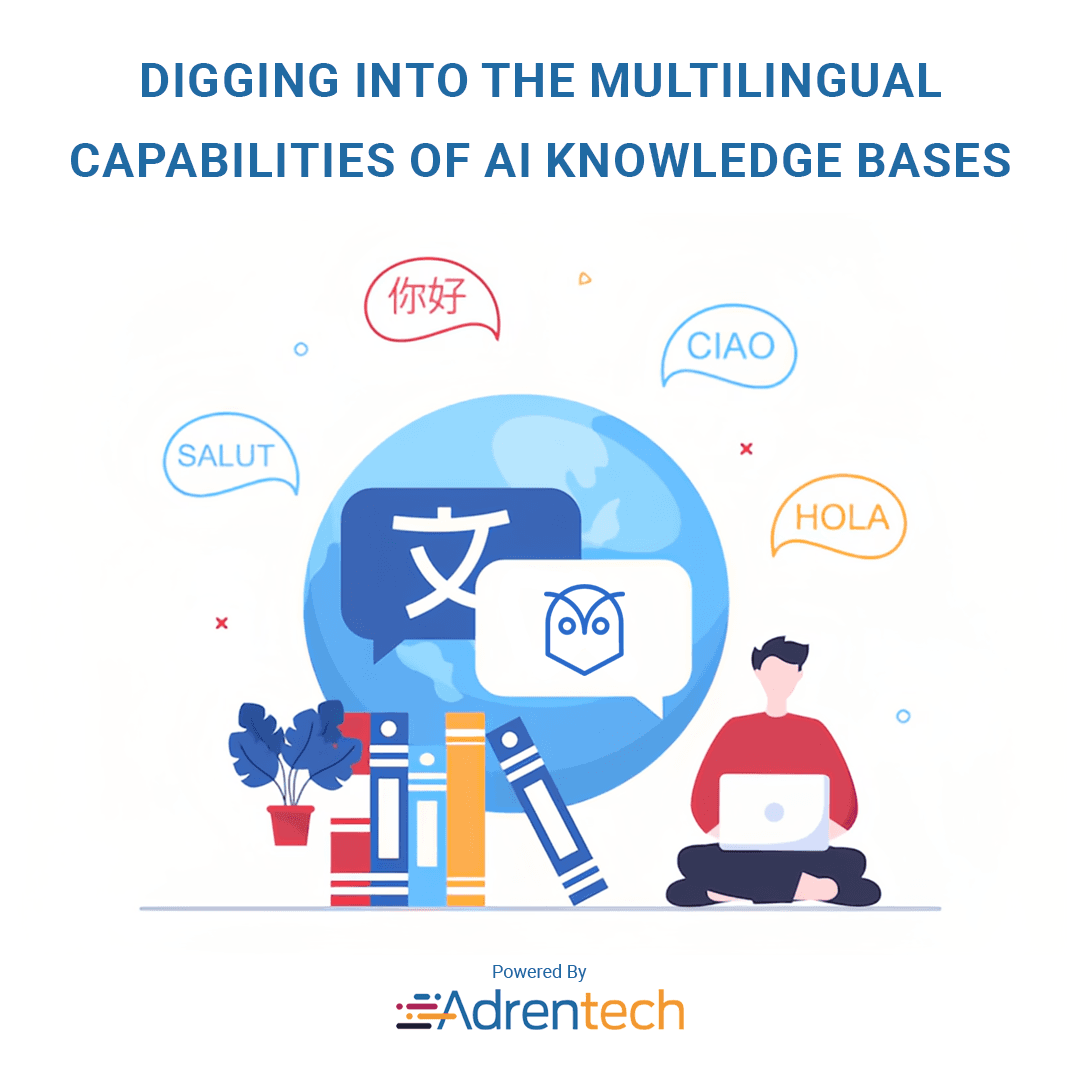
Digging into the Multilingual Capabilities of AI Knowledge Bases
Jazmine
April 10, 2025
In a world increasingly dependent on digital tools to provide global connections, it can be safely said that ensuring the multilingual capability of our technology is in everyone’s best interest.
One of the key technologies where linguistic inclusivity is becoming a necessity is the fast-growing space of Large Language Models (LLMs). In this article, we’ll explore what multilingual capability means for LLMs—distinct from cross-lingual capability—and why this distinction matters.
Table of Contents
- Definitions
- The Multilingual Divide
- Developmental Imbalances of LLMs
- What Are the Advantages of Multilingual LLMs?
- Multilingual LLMs in AI-Powered Knowledge Bases
- Ready to Learn More?
Definitions
- Multilingual Capability: An LLM’s ability to interpret and generate text in multiple languages.
- Cross-lingual Capability: A more complex skill (not covered here), where an LLM can transfer learned knowledge from one language to another.
The Multilingual Divide
Today, there are many high-quality LLMs available, such as OpenAI’s ChatGPT, Google’s Gemini, and Meta’s LLaMA. However, these tools tend to work best for high-resource languages like English.
A high-resource language has a large amount of accessible training data. Examples include English, Chinese, and Spanish.
For speakers of the world’s other ~7,000 languages, access to quality LLMs is limited. This imbalance stems from a key issue known as the resourcedness gap.
Developmental Imbalances of LLMs
The developmental discrepancy—or the challenge of building language-inclusive LLMs—has a few major causes.
The Resourcedness Gap
Just as half of all internet content is in English, most LLM training data is also in English or other high-resource languages. This skews model performance toward those languages and away from low-resource languages—those with little available training data.
Impacts of the Imbalance
The lack of multilingual support can lead to:
- Performance Issues: Poor, inaccurate, or low-quality outputs in response to low-resource language inputs.
- Cultural Bias: Assumptions that reflect only dominant cultures, ignoring regional or minority perspectives.
- Poor Language Representation: Errors in grammar, structure, or scripts of lesser-supported languages.
This isn’t just a social equity issue—it also limits how effectively global businesses can serve their full client base. But it doesn’t have to stay that way.
What Are the Advantages of Multilingual LLMs?
Now that we've covered the causes and consequences of multilingual gaps, let’s highlight the key benefits of building LLMs with multilingual capabilities:
1. Improved Global Capabilities for Businesses
Multilingual LLMs help companies meet customers where they are, linguistically and culturally—critical for any organization with global ambitions.
2. Safer and More Secure Content Generation
Better language understanding reduces risks tied to misinterpretation, mistranslation, and unsafe content generation.
3. Enhanced Localization
Models can grasp cultural nuance and context, enabling localized support tailored to specific regions and audiences.
Multilingual LLMs in AI-Powered Knowledge Bases
An AI knowledge base combines a company’s internal knowledge with AI tools to deliver instant, natural-language responses to customer queries.
What is an AI knowledge base? Read more here.
When you combine this with multilingual LLMs, the advantages multiply:
Benefits of Multilingual AI Knowledge Bases
More Customer-Aligned Support
Serve customers in their native language without long wait times. This improves satisfaction and boosts brand loyalty.Reduced Dependence on Human Agents
As companies grow, relying on a few bilingual agents becomes unsustainable. A multilingual AI platform reduces the need for extensive hiring or training.Increased Global Reach & Consistency
Ensure consistent, high-quality service across regions—breaking down language barriers while maintaining uniform customer experience.
Ready to Learn More?
Explore how multilingual AI knowledge bases can transform your business.
Check out Adrentech’s take on knowledge platforms — Norm — or book a demo here!
Share on social media


Types of Warehouse Management Systems