Voice of the Customer Analytics: How to Turn Call Recordings into Customer Insights
Anita
October 2, 2026
Voice of the Customer Analytics: How to Turn Call Recordings into Customer Insights
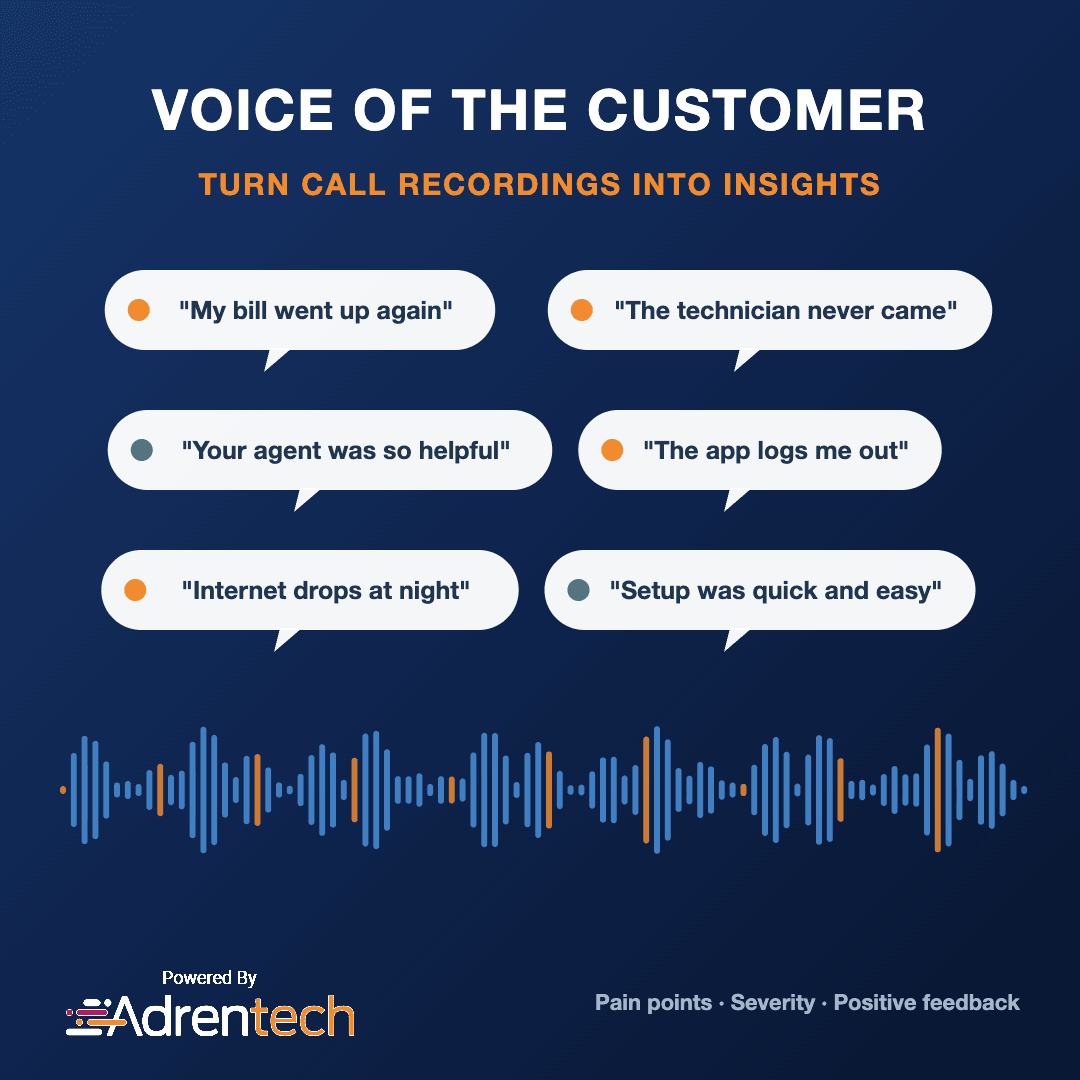
Voice of the customer (VoC) analytics collects and analyzes what customers say about their experience, so the business can understand their needs, pain points and expectations. Surveys and reviews are the usual sources, but call recordings are often the largest and most honest VoC dataset a company owns: customers explain their problems in detail, in their own words, at the moment they matter.
Adrentech Inform analyzes 100% of call recordings and turns them into VoC data: pain-point categories, descriptions and severity, negative service categories, positive feedback, outage reports and recurring issues, all linked to call reasons and outcomes.
Table of Contents
- Key takeaways
- What is voice of the customer analytics?
- Why call recordings are a powerful VoC source
- What VoC data to extract from calls
- How to build a VoC program from call recordings
- Pain points vs. sentiment
- How Adrentech Inform powers voice of the customer analytics
- Common VoC mistakes
- Frequently asked questions
- Hear what your customers are telling you
Key takeaways
- Calls capture unsolicited, detailed feedback from customers who cared enough to call.
- Surveys tell you how customers feel; calls tell you why.
- Track pain points by category and severity, not just sentiment.
- Positive feedback matters too: it shows what to protect and repeat.
- VoC insights only create value when they reach the teams that own the cause — product, billing, operations and marketing.
What is voice of the customer analytics?
VoC analytics is the process of gathering customer feedback from many sources, structuring it, and turning it into insights the business can act on.
| Source | What it captures | Limitation |
|---|---|---|
| Surveys (CSAT, NPS) | A score and an optional comment | Low response rates; little detail |
| Online reviews | Public opinions | Skewed toward extremes |
| Chat and email | Written conversations | Covers only some customers |
| Call recordings | Detailed, spoken explanations | Hard to analyze at scale without AI |
AI call analysis removes the main limitation of call recordings: the volume.
Why call recordings are a powerful VoC source
- Unsolicited feedback. Customers raise what matters to them, not what a survey asks about.
- Rich context. Customers explain what happened, what they tried and what they expected.
- Real-time signal. New problems show up in calls immediately, before surveys or reviews catch up.
- Linked to outcomes. Each piece of feedback is tied to a call reason, a resolution status and sometimes a cancellation.
- Full coverage. Analyzing every call avoids the bias of who chooses to answer a survey.
What VoC data to extract from calls
| Data point | What it tells you |
|---|---|
| Pain-point category | The area of the experience that failed (billing, installation, product, service) |
| Pain-point description | What exactly went wrong, in specific terms |
| Pain-point severity | How serious the problem was for the customer |
| Negative service categories | Where service fell short (wait times, repeated contacts, agent knowledge) |
| Positive feedback | What customers praised and want you to keep |
| Recurring issues | Problems customers mention again and again |
| Outage reports | Service disruptions reported by customers |
| Churn indicators | Signals that a pain point may lead to cancellation |
How to build a VoC program from call recordings
- Analyze every call. Extract pain points, feedback and call reasons consistently.
- Use a stable taxonomy. Group pain points into categories that match how your business is organized, so each category has an owner.
- Rank by volume and severity. A frequent minor annoyance and a rare severe failure both need attention, in different ways.
- Link to outcomes. Connect pain points to resolution, repeat calls and cancellations to show business impact.
- Share with owners. Send each category's findings, with example calls, to the team that can fix it.
- Track progress. Re-measure each pain point after a fix to confirm it went down.
- Report to leadership. Summarize top pain points, trends and actions in your regular executive reporting.
Pain points vs. sentiment
Sentiment tells you that a customer was unhappy; pain-point analysis tells you why. A sentiment score alone cannot be assigned to a team or fixed. A pain point such as "bill increased after promotion ended without notice" can be owned by billing and marketing, tracked weekly and reduced.
That is why Inform focuses on specific pain-point categories, descriptions and severity rather than a single emotion score.
How Adrentech Inform powers voice of the customer analytics
Inform reads every call and turns customer feedback into structured, trendable data.
- Pain-point categories, descriptions and severity for each call.
- Negative service categories that show where the service experience fell short.
- Positive feedback captured alongside complaints.
- Recurring issues and outage reports that point to root causes outside the contact center.
- Unmapped issues and topics kept visible, so new problems are not hidden inside existing categories.
- Churn risk and indicators that connect pain points to cancellations.
- Call reasons and resolution on the same call for full context.
- Scheduled report subscriptions to send VoC summaries to stakeholders by email.
Example questions you can ask Inform
- "What were the top pain-point categories last month?"
- "Which pain points had the highest severity this quarter?"
- "Show recurring issues by week for the last 8 weeks."
- "What positive feedback did customers give most often?"
- "Which pain points appear most often on calls with high churn risk?"
- "Show me example calls about installation delays."
Common VoC mistakes
- Relying only on surveys. Survey responders are not representative of all customers.
- Stopping at sentiment. Emotion scores do not tell teams what to fix.
- No owner per category. Insights without owners do not lead to change.
- Ignoring positive feedback. Knowing what works helps you protect it during changes.
- Not closing the loop. Re-measure after each fix to prove impact.
Frequently asked questions
What is voice of the customer analytics?
Voice of the customer analytics is the collection and analysis of customer feedback from sources such as surveys, reviews, chats and calls, to understand customer needs and pain points and act on them.
Why use call recordings for VoC?
Calls contain detailed, unsolicited feedback in the customer's own words and cover far more customers than surveys. AI makes it possible to analyze all of them.
What is a customer pain point?
A pain point is a specific problem a customer experienced, such as a billing error, a delayed installation or a confusing process, that caused frustration or extra effort.
How is pain-point analysis different from sentiment analysis?
Sentiment analysis measures how customers feel. Pain-point analysis identifies what caused the feeling, which makes it possible to assign an owner and fix it.
How does Adrentech Inform support VoC programs?
Inform analyzes every call for pain-point categories, descriptions and severity, negative and positive feedback, recurring issues and outages, and links them to call reasons, resolution and churn risk.
Can VoC insights from calls be shared automatically?
Yes. Inform reports can be scheduled as recurring email subscriptions for any group of stakeholders.
Hear what your customers are telling you
Turn every call into customer insight. Book an Inform demo or contact the Adrentech team. To see why customers call in the first place, read call driver analysis.
Share on social media


Call Center Compliance Monitoring: How AI Checks Every Call for Policy and Verification