First Call Resolution: How to Measure FCR Accurately and Improve It with AI Call Analysis
Anita
October 2, 2026
First Call Resolution: How to Measure FCR Accurately and Improve It with AI Call Analysis
First call resolution (FCR) is the share of customer issues fully resolved on the first contact, with no need for the customer to call back, be transferred again or follow up. It is closely linked to customer satisfaction, cost per contact and agent efficiency, which is why it appears on almost every contact center scorecard.
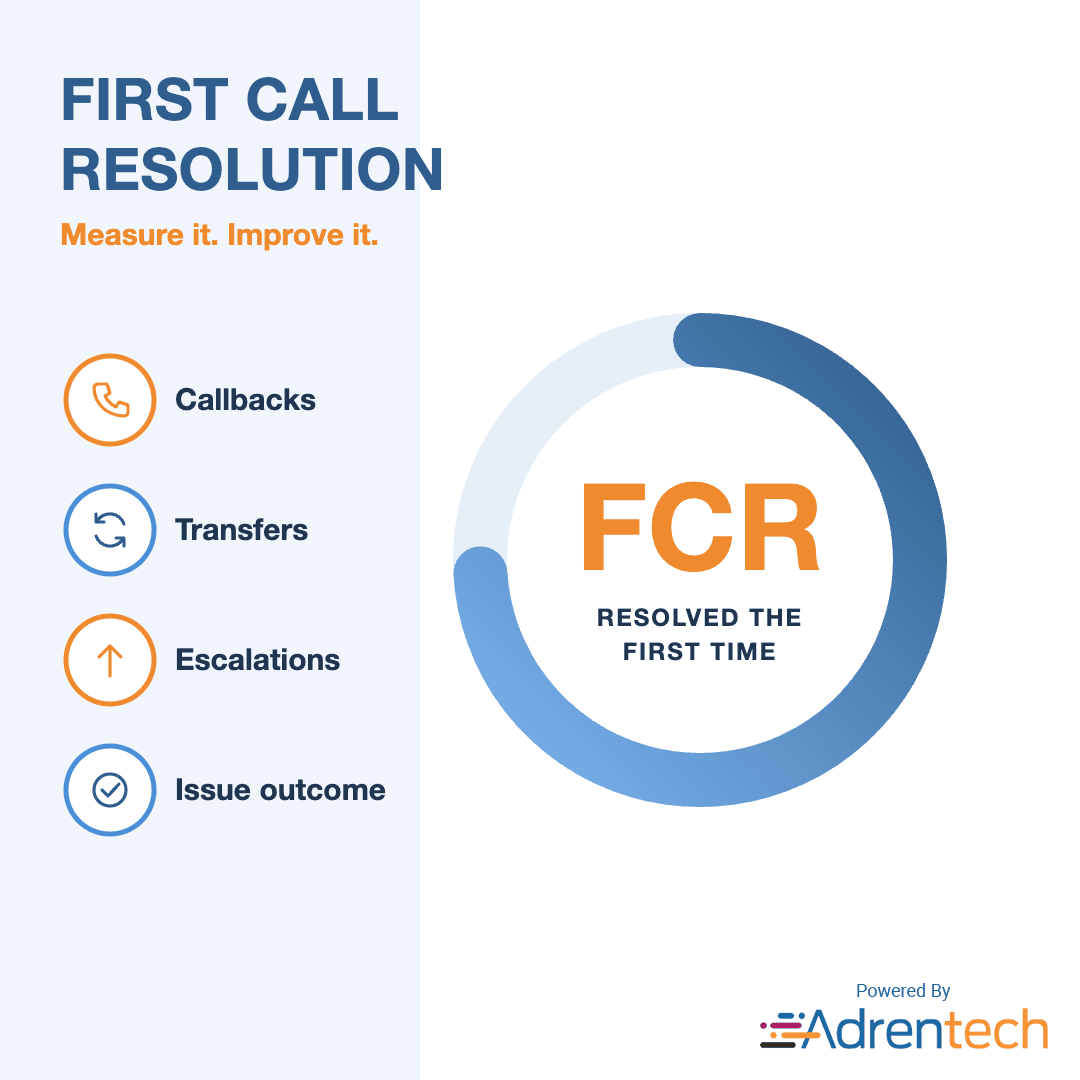
The problem is that FCR is hard to measure well. Surveys reach few customers, agent-selected codes are subjective, and repeat-call rules miss customers who give up. Adrentech Inform adds a direct measure: it analyzes every call and records whether the customer's issue was solved, whether a callback was requested, whether the call was escalated or transferred, and whether the issue is a recurring one.
Table of Contents
- Key takeaways
- What is first call resolution?
- Why FCR matters
- How to measure first call resolution
- What lowers first call resolution
- How to improve first call resolution step by step
- FCR-related metrics to track
- How Adrentech Inform helps measure and improve FCR
- Common FCR mistakes
- Frequently asked questions
- What is first call resolution?
- How is FCR calculated?
- What is the most accurate way to measure FCR?
- How do transfers affect first call resolution?
- Can AI measure first call resolution?
- How does Inform help improve FCR?
Key takeaways
- FCR measures whether the customer's problem was solved the first time, not whether the call ended quickly.
- No single FCR method is perfect; the most reliable approach combines conversation analysis with repeat-contact data.
- Conversation analysis shows why issues were not resolved, which surveys and repeat-call rules cannot.
- The biggest FCR killers are transfers, missing authority, knowledge gaps and upstream process failures.
- FCR should be tracked by call reason, because each reason has its own resolution problems.
What is first call resolution?
First call resolution is the percentage of issues resolved during the customer's first contact. A simple formula is:
FCR = (issues resolved on first contact ÷ total issues) × 100
What counts as "resolved" is the hard part. A call can end politely while the problem remains, or an issue can be fixed but require a follow-up the customer did not expect.
Why FCR matters
Every unresolved issue creates more work and a less satisfied customer. Low FCR leads to:
- Higher call volume, because unresolved customers call again.
- Higher cost, because one issue consumes several contacts.
- Lower satisfaction, because customers have to repeat themselves.
- Higher churn risk, because repeated problems are a common reason customers leave. See call center churn analysis.
- Agent frustration, because agents handle the same angry customers again.
How to measure first call resolution
| Method | How it works | Strengths | Weaknesses |
|---|---|---|---|
| Customer surveys | Ask "Was your issue resolved?" | The customer's view | Low response rates, biased samples |
| Agent disposition | Agent marks the call resolved | Easy to collect | Subjective and inconsistent |
| Repeat-contact rule | No repeat call within X days | Objective | Misses customers who give up or switch channels |
| Conversation analysis | AI reads the call to judge resolution | Covers every call and explains why | Needs good analysis rules |
The strongest approach combines conversation analysis (did the call resolve the issue, and if not, why?) with repeat-contact data (did the customer come back?).
What lowers first call resolution
- Transfers. Each transfer adds a hand-off where context and ownership can be lost.
- Missing authority. Agents cannot approve a credit, exception or technician visit.
- Knowledge gaps. Agents do not know the answer or cannot find it quickly. A strong AI knowledge base helps here.
- System and process failures. The fix depends on another team, a ticket or a delivery.
- Recurring issues and outages. The root cause is outside the contact center.
- Multi-issue calls. The customer had a second problem that was never addressed.
How to improve first call resolution step by step
- Measure resolution on every call. Use conversation analysis to know which calls were resolved.
- Break FCR down by call reason. Each reason has different blockers.
- Find the "why not". For unresolved calls, look at transfers, escalations, callback requests and recurring issues.
- Fix the top blocker for each top reason. Training, knowledge, authority or upstream process.
- Reduce unnecessary transfers. Improve routing and give first-line agents the tools to finish more issues.
- Track secondary reasons. Make sure agents address every issue raised.
- Re-measure monthly. Confirm that each fix actually raised resolution for that reason.
FCR-related metrics to track
| Metric | What it tells you |
|---|---|
| Issue resolution rate | Share of calls where the issue was solved |
| Resolution rate by call reason | Which problems are hardest to solve |
| Callback requests | Calls that ended with a promised follow-up |
| Escalation rate | Calls that needed a supervisor or specialist |
| Transfer rate | Calls handed off to another queue or agent |
| Recurring issues | Problems customers report again and again |
| Outage reports | Issues caused by service disruptions |
How Adrentech Inform helps measure and improve FCR
Inform analyzes every call for resolution and the factors that block it.
- Issue outcome on every call. Inform's AI judges whether the customer's issue was solved.
- Callback requests, escalations and transfers recorded per call.
- Recurring issues and outage reports that point to causes outside the contact center.
- Call reasons on the same call, so resolution can be broken down by reason.
- Transfer-aware segments. Inform detects each customer–agent segment in a transferred call, so you can see which queue handled which part of the issue.
- Agent and team views. Compare resolution fairly across agents handling the same call reasons.
- Proactive solutions. Inform also tracks whether agents offered proactive solutions that prevent the next call.
Example questions you can ask Inform
- "What was the issue resolution rate last month?"
- "Show resolution rate by top 10 call reasons."
- "Which call reasons have the most callback requests?"
- "How many calls were transferred last week, by workgroup?"
- "What are the most common recurring issues this quarter?"
Common FCR mistakes
- Rewarding short calls. Pushing average handle time down can push FCR down too.
- Relying on agent codes alone. Self-reported resolution is usually too optimistic.
- Measuring one overall number. FCR only becomes actionable when split by call reason.
- Ignoring transfers. A "resolved" call that needed three hand-offs is not a good experience.
- Treating outages as agent problems. Some unresolved calls can only be fixed outside the contact center.
Frequently asked questions
What is first call resolution?
First call resolution is the percentage of customer issues fully resolved during the first contact, without the customer needing to call back or follow up.
How is FCR calculated?
A common formula is the number of issues resolved on first contact divided by the total number of issues, multiplied by 100. The key is defining "resolved" consistently.
What is the most accurate way to measure FCR?
Combining conversation analysis, which judges resolution on every call and explains failures, with repeat-contact data, which shows whether customers came back.
How do transfers affect first call resolution?
Transfers add hand-offs where context can be lost and often signal that the first agent could not resolve the issue. Reducing unnecessary transfers usually improves FCR.
Can AI measure first call resolution?
Yes. AI call analysis can read each conversation and record whether the issue was solved, plus related signals such as callback requests, escalations, transfers and recurring issues.
How does Inform help improve FCR?
Inform shows resolution by call reason, agent and workqueue, along with the transfers, callbacks, escalations and recurring issues behind unresolved calls, so teams can fix the biggest blockers first.
Improve resolution with real call data
See which issues your team resolves the first time, and why others need another call. Book an Inform demo or contact the Adrentech team. To understand what drives your call volume, read call driver analysis.
Share on social media


Conversation Intelligence vs. Speech Analytics: What Is the Difference and Which Do You Need?