Emerging Issue Detection: How to Spot Outages and New Problems in Customer Calls Early
Anita
October 19, 2026
Emerging Issue Detection: How to Spot Outages and New Problems in Customer Calls Early
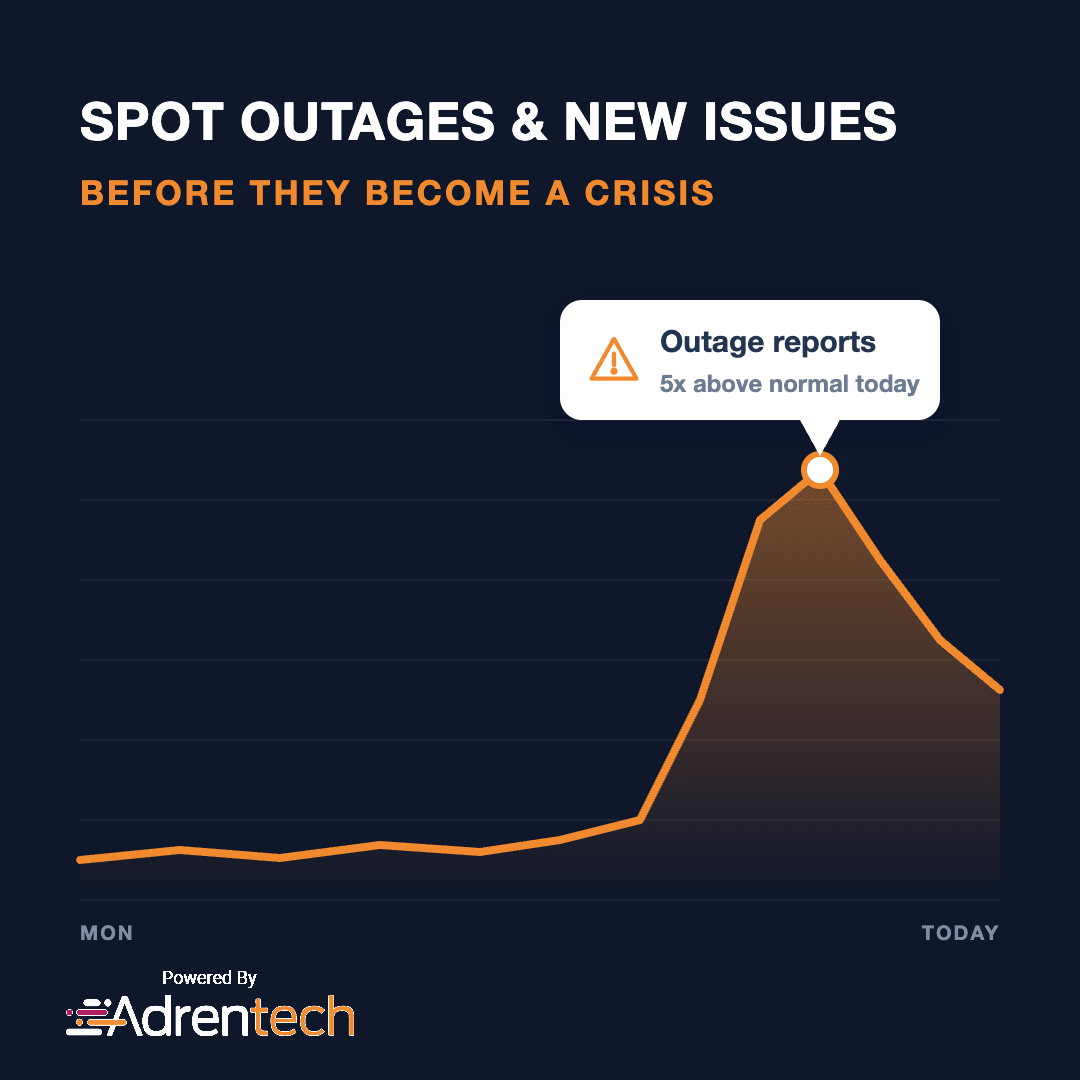
Emerging issue detection is the practice of spotting new or growing customer problems — outages, product defects, billing errors, broken processes — as soon as they start appearing in customer contacts. Customers are often the first to notice when something breaks. They call before a monitoring alert fires, before a ticket is escalated, and long before a monthly report shows a trend.
Adrentech Inform analyzes 100% of call recordings and records outage reports, recurring issues, call reasons and topics on every call. Values that do not fit the existing vocabulary are kept as "unmapped" issues and topics, so brand-new problems are visible instead of being hidden in an "Other" bucket.
Table of Contents
- Key takeaways
- What counts as an emerging issue?
- Why calls catch issues early
- Signals to watch
- How to detect emerging issues step by step
- How Adrentech Inform surfaces emerging issues
- From detection to action
- Common mistakes
- Frequently asked questions
- Catch problems before they grow
Key takeaways
- Customer calls are an early-warning system for outages and defects.
- New problems usually appear first as unfamiliar wording, not as a known category.
- Volume alone is not enough; look at growth rate, concentration and repetition.
- Recurring issues show problems that are not being fixed at the root.
- Detection only matters if there is a fast route from the contact center to the team that can fix it.
What counts as an emerging issue?
| Type | Example | Typical owner |
|---|---|---|
| Service outage | Internet or app unavailable in one area | Network / IT operations |
| Product defect | Device keeps rebooting after an update | Product / engineering |
| Billing error | Customers charged twice after a system change | Billing |
| Process failure | Confirmation emails not sent | Operations |
| Policy change confusion | New fee customers did not expect | Marketing / communications |
Why calls catch issues early
- Customers call immediately. When something stops working, the phone is often the first channel they use.
- They describe symptoms in detail. Location, device, time and error messages are often mentioned.
- Volume grows quickly. A real outage produces many similar calls in a short time.
- Not every problem triggers an alert. Process and communication failures rarely show up in system monitoring.
Signals to watch
| Signal | What it suggests |
|---|---|
| Sudden rise in one call reason | A new problem is affecting many customers |
| Outage mentions | Customers report service disruptions |
| New unmapped issue wording | A problem your categories do not yet cover |
| Growth in recurring issues | A known problem is not fixed at the root |
| Concentration in one queue or segment | The problem affects a specific product or customer group |
| Rise in callbacks and escalations | Agents cannot resolve the new problem |
How to detect emerging issues step by step
- Analyze every call quickly. Sampling and slow processing delay detection.
- Normalize known issues. Map different wording to consistent call reasons and issue categories.
- Keep unmapped values visible. Review new issue wording that does not match any category.
- Trend by day or week. Compare each reason and issue with its recent baseline.
- Slice by context. Break spikes down by queue, workgroup, dialed number and customer segment.
- Read the example calls. Confirm the problem and collect details such as location or device.
- Alert the owner. Send a short summary with counts and examples to the responsible team.
- Track until resolved. Watch the issue's call volume fall after the fix.
How Adrentech Inform surfaces emerging issues
- Outage reports captured from customer conversations.
- Recurring issues that show problems customers report again and again.
- Unmapped issues and unmapped topics so new problems stay visible until they are added to the vocabulary.
- Call reasons, topics and drivers normalized for reliable trending.
- Escalations and callback requests that show when agents cannot resolve a new problem.
- Trends and period comparisons in plain-English questions, broken down by workgroup, agent or other dimensions.
- Example calls linked to every answer for quick confirmation.
- Scheduled reports that send issue summaries to stakeholders by email.
Example questions you can ask Inform
- "Show outage reports by day for the last two weeks."
- "Which call reasons grew the most this week compared with last week?"
- "What are the top unmapped issues this month?"
- "Which recurring issues have the most calls this quarter?"
- "Show me example calls about the new billing fee."
From detection to action
| Step | Who | Output |
|---|---|---|
| Detect | Contact center analytics | Spike or new issue identified |
| Confirm | Supervisor or analyst | Example calls reviewed |
| Notify | Contact center lead | Short summary to the owning team |
| Communicate | Marketing / operations | Proactive message, IVR announcement or web banner |
| Equip agents | Knowledge team | Updated script or knowledge base article |
| Verify | Analytics | Issue volume falls after the fix |
A proactive IVR message or website banner during an outage can prevent many repeat calls. Updating agent guidance quickly keeps answers consistent.
Common mistakes
- Waiting for monthly reports. By then, the issue has already cost calls and customers.
- Forcing new problems into old categories. "Other" hides exactly what you need to see.
- Looking only at total volume. A small but fast-growing issue is often more urgent than a large stable one.
- No owner outside the contact center. Detection without a fix only creates more calls.
Frequently asked questions
What is emerging issue detection?
It is the process of spotting new or growing customer problems, such as outages, defects or billing errors, as they start appearing in customer contacts.
Can customer calls detect outages?
Yes. Customers often report service disruptions by phone, and analyzing calls for outage mentions and sudden call reason spikes can reveal a problem early.
What are unmapped issues?
Unmapped issues are problems described in calls that do not match any existing category. Keeping them visible helps teams spot new problems instead of hiding them under "Other".
How often should calls be analyzed for emerging issues?
As close to continuously as practical. The faster calls are analyzed, the earlier a spike can be noticed.
What is a recurring issue?
A recurring issue is a problem customers report repeatedly, which usually means the root cause has not been fixed.
How does Inform help teams act on emerging issues?
Inform shows outage reports, recurring issues, unmapped issues and call reason trends, links them to example calls, and can deliver scheduled summaries to the teams that own the fix.
Catch problems before they grow
See emerging issues and outages in your own calls. Book an Inform demo or contact the Adrentech team. Related reading: call driver analysis and voice of the customer analytics.
Share on social media


Call Center Transcription Accuracy: Why It Matters for AI Call Analysis and How to Improve It