Call Transfer Analysis: How to Reduce Unnecessary Transfers in Your Contact Center
Anita
October 19, 2026
Call Transfer Analysis: How to Reduce Unnecessary Transfers in Your Contact Center
Call transfer analysis looks at every call that moves from one agent or queue to another, to find out why the transfer happened, whether it was necessary, and how it affected the customer's outcome. Some transfers are the right thing to do. Many are not: the call reached the wrong queue, the first agent lacked authority or knowledge, or the routing menu sent the customer to the wrong place.
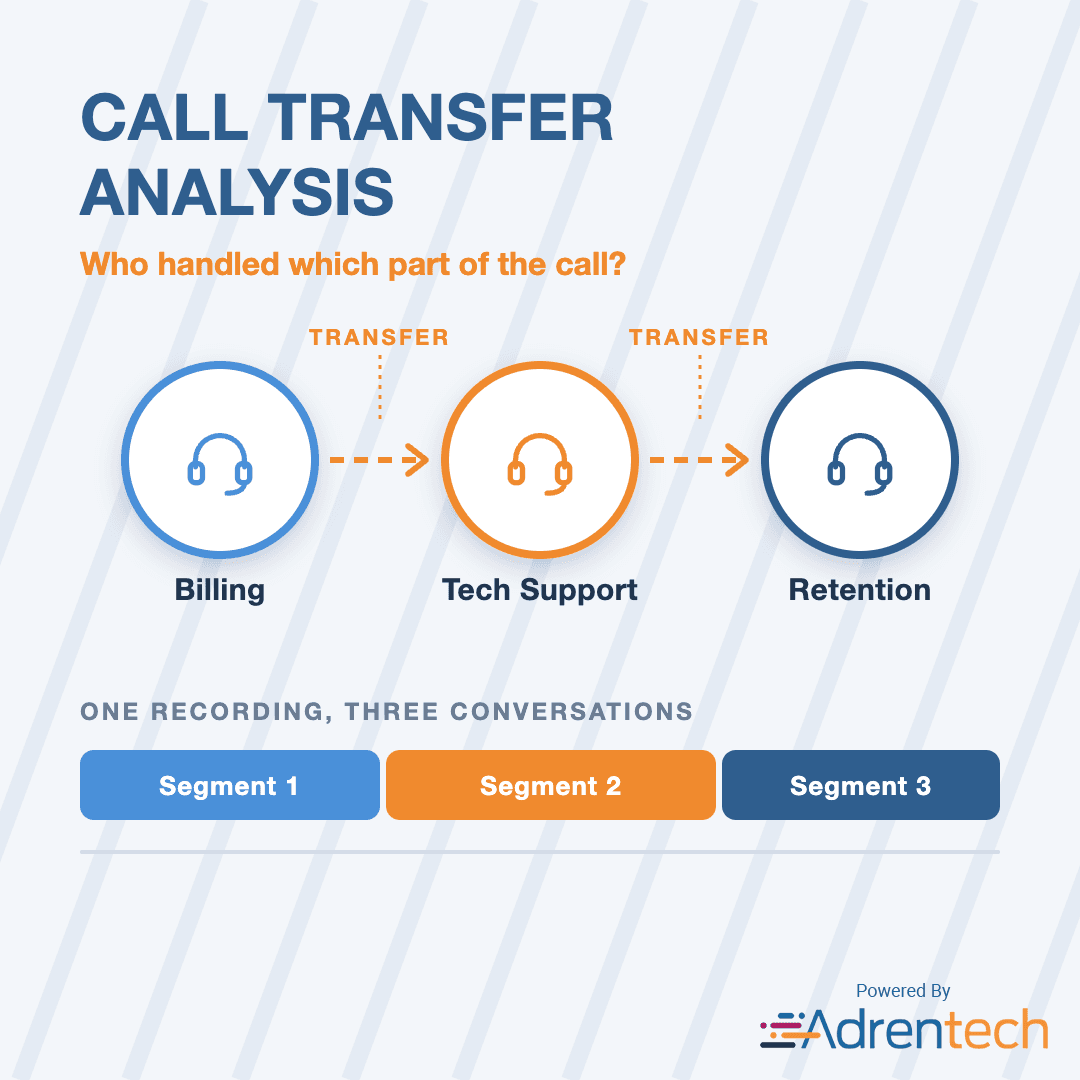
The difficulty is that a transferred call is usually stored as one recording with several conversations inside it. Adrentech Inform detects each customer–agent segment in a recording and analyzes it separately, so you can see who handled which part of the call, why it was transferred, and how it ended.
Table of Contents
- Key takeaways
- What is a call transfer?
- Why transfers matter
- Why transferred calls are hard to analyze
- How to analyze call transfers step by step
- Transfer metrics to track
- How Adrentech Inform analyzes transferred calls
- How to reduce avoidable transfers
- Common mistakes in transfer analysis
- Frequently asked questions
- What is call transfer analysis?
- What is a good call transfer rate?
- How do you analyze a call that was transferred several times?
- Why is it unfair to score agents on transferred calls?
- Does Inform need complete call path data to analyze transfers?
- Can Inform evaluate only the retention part of a transferred call?
Key takeaways
- A transfer is a hand-off; every hand-off is a chance to lose context, time and customer patience.
- Not all transfers are bad. The goal is to remove avoidable ones, not all of them.
- Transfers can only be analyzed properly when each part of the call is measured on its own.
- The most useful view combines the transfer reason, the sending queue, the receiving queue and the final outcome.
- Reducing avoidable transfers usually improves first call resolution and handle time at the same time.
What is a call transfer?
A call transfer happens when a call is passed from one agent, queue or department to another during the same contact.
| Transfer type | What happens | Typical example |
|---|---|---|
| Warm transfer | The first agent introduces the customer to the next agent | Billing agent hands over to retention |
| Cold (blind) transfer | The call is moved without an introduction | Agent sends the call to technical support |
| Escalation | The call goes to a supervisor or specialist | Complaint needs approval for a credit |
| Misroute correction | The call reached the wrong queue and is moved | Sales call landed in support |
Why transfers matter
Each transfer adds a hand-off where the customer may have to repeat themselves, wait again, or be dropped. High transfer rates usually point to:
- Routing problems. The phone menu or routing rules send customers to the wrong queue.
- Skill or authority gaps. First-line agents cannot finish certain requests.
- Knowledge gaps. Agents are unsure of the answer and pass the call on.
- Process design. Some requests are designed to require a specialist, even when they are simple.
Transfers also distort reporting. If a call is measured only at the last queue, the last agent gets credit or blame for the whole call, and the queue that first received it disappears from the data.
Why transferred calls are hard to analyze
- One recording, several conversations. The first agent, the specialist and sometimes a third agent are all in one audio file.
- Metadata favors the last hop. Telephony data often records the final queue and final agent reliably, but not the first or middle ones.
- Call path data can be truncated or arrive late. The list of steps a call took may be incomplete.
- Whole-call scoring is unfair. An evaluation of the full call blends several agents' work.
How to analyze call transfers step by step
- Split each call into conversation segments. Identify where one customer–agent conversation ends and the next begins.
- Attribute each segment. Link each segment to its probable agent and workqueue, using call path data where available.
- Record the reason for the transfer. Capture why the customer was moved: wrong queue, needs specialist, needs approval, customer request.
- Record the outcome per segment. Was the issue resolved in the receiving segment?
- Measure transfer flows. Which queues send the most transfers, and where do they go?
- Separate avoidable from necessary transfers. Misroutes and knowledge gaps are avoidable; specialist cases may not be.
- Fix the top flows. Update routing, training, knowledge or authority for the largest avoidable flows.
Transfer metrics to track
| Metric | What it tells you |
|---|---|
| Transfer rate | Share of calls with at least one transfer |
| Transfers by sending queue | Which teams pass on the most calls |
| Transfers by receiving queue | Which teams receive the most hand-offs |
| Transfer reasons | Why calls are moved |
| Resolution after transfer | Whether the receiving segment solved the issue |
| Segments per call | How many hand-offs customers experience |
| Transfers by call reason | Which customer needs are routed badly |
How Adrentech Inform analyzes transferred calls
Inform treats a transferred call as a sequence of conversations, not as one block of audio.
- Automatic segment detection. During normal analysis, Inform finds the customer–agent conversation segments in each recording. Every call has at least one segment, and simple calls are not analyzed twice.
- Segment-level analysis. For transferred calls, Inform produces call-level rollup data and segment-level data in the same analysis flow.
- Probable agent and workqueue per segment. Inform uses imported call metadata and call path data to label first, middle and final segments, and handles missing, late or truncated call path data without failing.
- Segment-level sales and retention data. Sales and retention outcomes are stored per segment, so a retention conversation that started in billing is measured as a retention conversation.
- Targeted evaluations. Agent Interaction Reports (AIR) can target full calls, specific segments, workqueues or queue groups, so each agent is scored only on their own part of the call.
- Transfer flags and call reasons. Each call records whether it was transferred, along with call reasons and resolution, so transfer flows can be broken down by customer need.
Example questions you can ask Inform
- "How many calls were transferred last week, by workgroup?"
- "Which call reasons are transferred most often?"
- "What is the resolution rate on calls that were transferred to retention?"
- "Show me calls transferred from billing to technical support."
How to reduce avoidable transfers
| Root cause | Fix |
|---|---|
| Customers choose the wrong menu option | Simplify the IVR and test option wording |
| Routing rules send calls to the wrong skill | Update routing using call reason data |
| First-line agents lack authority | Expand approval limits for common, low-risk requests |
| Agents do not know the answer | Improve knowledge and agent assist tools |
| Simple requests require specialists by design | Redesign the process or move it to self-service |
Every avoidable transfer you remove also helps first call resolution and reduces repeat calls.
Common mistakes in transfer analysis
- Measuring only the final queue. It hides where calls entered and why they moved.
- Scoring agents on the whole call. Each agent should be measured on their own segment.
- Treating all transfers as failures. Some transfers are the right path; focus on the avoidable ones.
- Ignoring incomplete call path data. Use conversation analysis to fill gaps instead of dropping those calls.
Frequently asked questions
What is call transfer analysis?
Call transfer analysis reviews calls that move between agents or queues to understand why the transfer happened, whether it was avoidable, and how it affected the outcome.
What is a good call transfer rate?
It depends on your routing design and the complexity of your services. The most useful target is not a single number but a steady reduction in avoidable transfers, such as misroutes and knowledge gaps.
How do you analyze a call that was transferred several times?
Split the recording into customer–agent segments, attribute each segment to its agent and workqueue, and analyze the reason and outcome of each segment separately.
Why is it unfair to score agents on transferred calls?
A whole-call score blends the work of several agents. Segment-level scoring measures each agent only on the part of the conversation they handled.
Does Inform need complete call path data to analyze transfers?
No. Inform uses call path data when it is available, but it detects conversation segments from the call itself and handles missing, late or truncated metadata.
Can Inform evaluate only the retention part of a transferred call?
Yes. Agent Interaction Reports can target specific segments, workqueues or queue groups, so a retention evaluation covers only the retention conversation.
See your transfer flows in Inform
Find out where your calls are handed off and why. Book an Inform demo or contact the Adrentech team. For an overview of everything Inform extracts from a call, read AI call analysis software.
Share on social media


IVR Analysis: How to Use Call Recordings to Fix Your Phone Menu and Call Routing