Call Center Transcription Accuracy: Why It Matters for AI Call Analysis and How to Improve It
Anita
October 19, 2026
Call Center Transcription Accuracy: Why It Matters for AI Call Analysis and How to Improve It
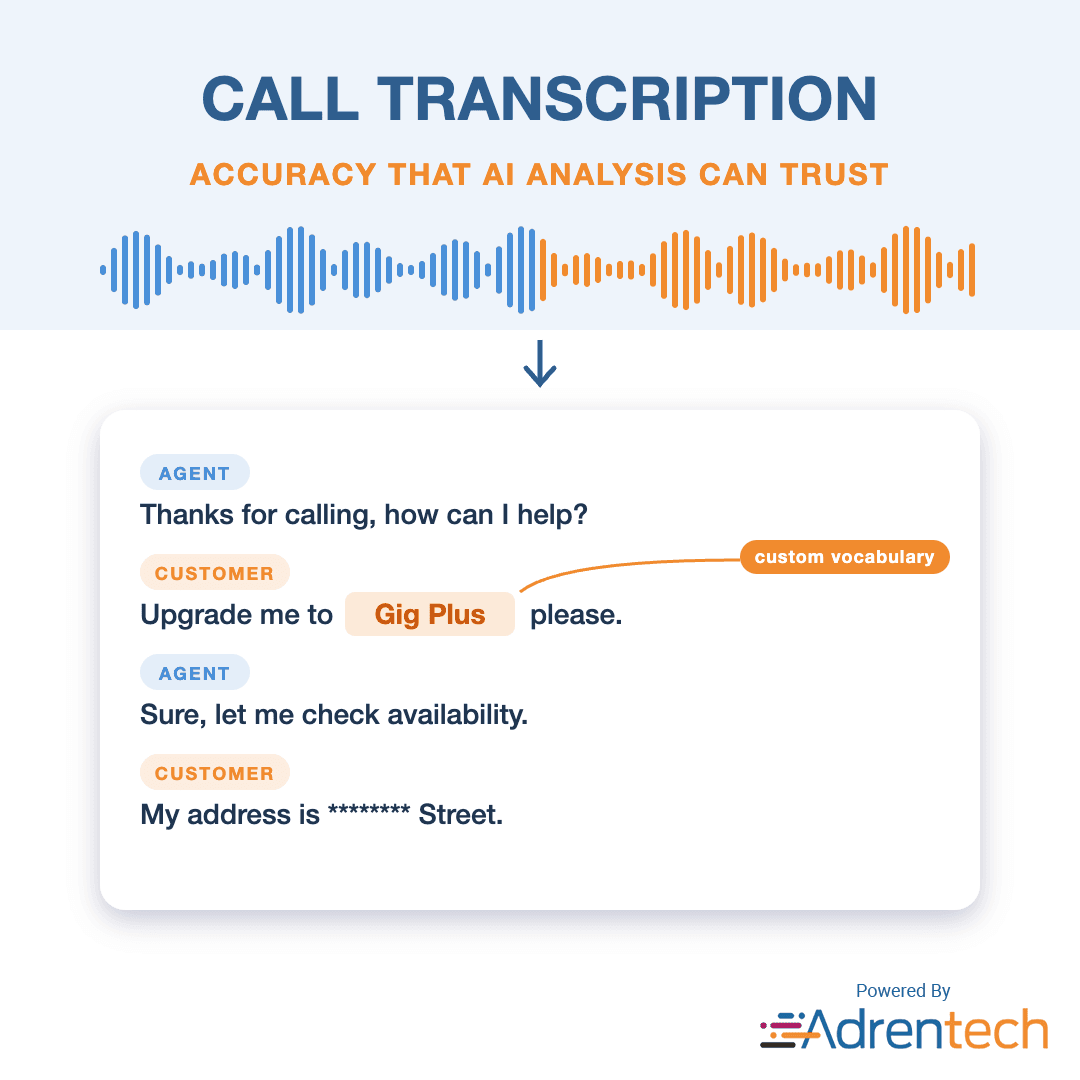
Call center transcription converts recorded phone conversations into text, labeled by speaker, so they can be searched, analyzed and scored. Every downstream result — call reasons, outcomes, compliance checks, agent scores — depends on that text. A misheard product name, a missing sentence or a mixed-up speaker can change the answer.
Adrentech Inform transcribes calls with Whisper-based speech recognition, labels who is speaking, applies a custom vocabulary of corrections, checks transcript quality, and lets users report transcription problems so they can be reviewed and fixed.
Table of Contents
- Key takeaways
- Why transcription accuracy matters
- What affects speech-to-text accuracy on phone calls
- Speaker labeling (diarization)
- Custom vocabulary and word substitutions
- How to measure transcript quality
- How Adrentech Inform keeps transcripts reliable
- Best practices for better call transcription
- Frequently asked questions
- Start with transcripts you can trust
Key takeaways
- Transcript quality sets the ceiling for every AI insight built on top of it.
- Phone audio is harder than studio audio: narrow bandwidth, noise, cross-talk and hold music all hurt accuracy.
- Knowing who said what (speaker labeling) matters as much as the words themselves.
- Custom vocabulary fixes the errors that matter most: product names, plan names and industry terms.
- Quality checks and user feedback catch the problems that automated metrics miss.
Why transcription accuracy matters
| If the transcript gets this wrong | The analysis gets this wrong |
|---|---|
| A product or plan name | Call reasons, sales intents and topics |
| Who is speaking | Agent compliance, empathy and verification checks |
| A missing sentence | Outcomes, objections and resolution |
| A number or date | Verification evidence and follow-up details |
| Hold music transcribed as speech | Noise in topics and search results |
What affects speech-to-text accuracy on phone calls
- Audio quality. Phone lines carry less audio detail than in-person recordings.
- Background noise. Homes, cars and contact center floors add noise.
- Cross-talk. Customers and agents speak over each other.
- Accents and speaking speed. Wide variation across callers.
- Domain vocabulary. Brand names, product codes and jargon are not in general language models.
- Silence, hold and music. Long silent or musical stretches can produce odd text.
- Recording format. Mono recordings make it harder to separate speakers than dual-channel recordings.
Speaker labeling (diarization)
Speaker labeling, also called diarization, splits the transcript by speaker and assigns each part to the agent or the customer. It is essential for:
- Checking what the agent said (disclosures, verification, empathy).
- Understanding what the customer asked for and how they reacted.
- Detecting separate conversation segments in transferred calls.
When speaker labels are wrong, an agent can be credited with a customer's words or the other way round. Good systems review and correct speaker labels when the conversation does not make sense.
Custom vocabulary and word substitutions
General speech models do not know your product names. A custom vocabulary maps common mistakes to the right words, for example a misheard plan name to its real spelling. This is one of the highest-impact improvements because product and plan names drive call reasons, sales and topics.
How to measure transcript quality
| Method | What it shows |
|---|---|
| Spot checks against audio | Real accuracy on your calls |
| Automated quality indicators | Signs of problems such as very short output, repetition or long silences |
| Speaker label review | Whether agent and customer turns are assigned correctly |
| User-reported issues | Errors noticed by supervisors and analysts in daily use |
| Downstream checks | Fields that look wrong often point back to transcript errors |
How Adrentech Inform keeps transcripts reliable
- Whisper-based transcription of every call, with timed segments.
- Speaker labeling of agent and customer turns, with review and correction of speaker labels when needed.
- Custom word substitutions that correct product names and industry terms across transcripts.
- Sensitive data masking of card numbers, security codes, expiry dates and Social Security numbers. See PII redaction in call transcripts.
- Transcript quality assessment with quality indicators and reasons, so weak transcripts can be identified.
- Silence handling that tracks long silent stretches in a recording.
- Same-speaker joining that merges consecutive turns from one speaker for readability.
- Issue reporting. Users can report transcription issues and incorrect field values, with expected values and tags, for review.
Best practices for better call transcription
- Record in dual channel where possible. Separate agent and customer audio improves speaker labeling.
- Build a vocabulary list early. Start with products, plans, competitors and locations.
- Review a sample every week. Especially after launching new products or scripts.
- Make it easy to report errors. Supervisors notice problems first.
- Watch downstream fields. Unexpected call reasons often trace back to transcript errors.
- Mask sensitive data before indexing. Protect customers before transcripts spread to search and reports.
Frequently asked questions
Why is transcription accuracy important for call analytics?
All AI insights, from call reasons to agent scores, are built on the transcript. Errors in words or speaker labels lead directly to errors in analysis.
What is speaker diarization?
Speaker diarization separates a transcript by speaker and labels each part, for example as agent or customer.
How can I improve transcription of product names?
Use a custom vocabulary or word substitution list that maps common misrecognitions to the correct product and plan names.
What speech recognition does Inform use?
Inform uses Whisper-based speech recognition, combined with speaker labeling, custom word substitutions and quality checks.
Can users correct transcription errors in Inform?
Users can report transcription issues and incorrect values for review, and custom word substitutions can be added to fix recurring errors.
Does Inform protect sensitive data in transcripts?
Yes. Card numbers, security codes, expiry dates and Social Security numbers are masked in transcripts before analysis.
Start with transcripts you can trust
See how Inform transcribes and analyzes your calls. Book an Inform demo or contact the Adrentech team. Learn more in AI call analysis software.
Share on social media