PII Redaction in Call Transcripts: How to Protect Customer Data in Speech Analytics
Anita
October 2, 2026
PII Redaction in Call Transcripts: How to Protect Customer Data in Speech Analytics
PII redaction in call transcripts is the automatic detection and masking of personal and payment data — such as card numbers, security codes and Social Security numbers — before transcripts are stored, analyzed or read by people. It lets contact centers use AI call analysis on every conversation without spreading sensitive customer data across reports, dashboards and search results.
Customers read card numbers, account details and identity information aloud every day. Once speech becomes text, that data is easy to copy, search and share. Adrentech Inform masks common sensitive data in transcripts before analysis, and its AI is instructed to record verification evidence without repeating the actual values.
Table of Contents
- Key takeaways
- What is PII redaction?
- What sensitive data appears in call recordings?
- Why redaction matters more with AI call analysis
- How transcript redaction works
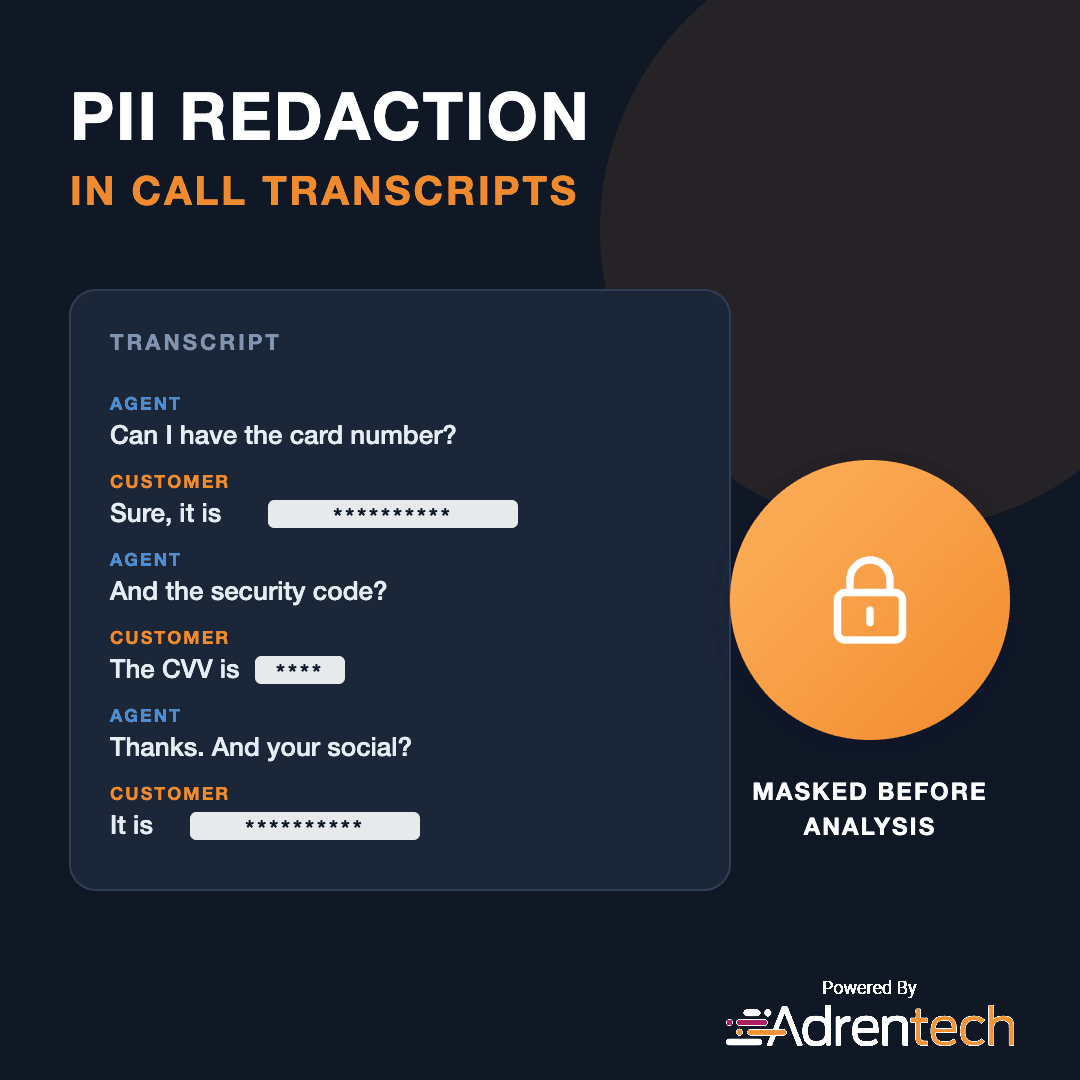
- What a redacted transcript looks like
- How Adrentech Inform protects transcript data
- Redaction best practices for contact centers
- Frequently asked questions
- Analyze every call without exposing customer data
Key takeaways
- Speech-to-text turns spoken sensitive data into searchable text, which increases exposure risk.
- The most common high-risk items in calls are payment card numbers, security codes, expiry dates and government identifiers.
- Redaction should happen before transcripts are analyzed, indexed or displayed.
- Good redaction balances protection with usefulness: it should mask secrets, not destroy the meaning of the conversation.
- Redaction is one layer; access control and data retention complete the picture.
What is PII redaction?
PII redaction replaces personally identifiable or sensitive information in a transcript with a mask, such as asterisks, so the value cannot be read or recovered from the text.
| Term | Meaning |
|---|---|
| PII | Personally identifiable information: data that can identify a person |
| Sensitive payment data | Card numbers, security codes (CVV/CVC) and expiry dates |
| Redaction / masking | Replacing a sensitive value with placeholder characters |
| Transcript | The text version of a call produced by speech recognition |
| Downstream use | Any place the transcript goes next: analysis, search, reports, exports |
What sensitive data appears in call recordings?
Any data a customer says aloud can end up in a transcript. In contact centers, the most common items are:
- Payment card numbers read out during payments or billing updates.
- Card security codes (CVV/CVC) and expiry dates.
- Social Security numbers or other national identifiers used for identity verification.
- Account and reference numbers used to locate a customer record.
- Links and tokens spoken or read back, such as survey links with unique identifiers.
- Personal details such as addresses, dates of birth and phone numbers.
Not all of these carry the same risk. Payment data and government identifiers are typically the highest priority to mask.
Why redaction matters more with AI call analysis
AI call analysis makes transcripts more useful, which also makes them more widely used. Once every call is transcribed and indexed:
- Supervisors search transcripts to find example calls.
- Reports quote parts of conversations as evidence.
- Large language models read transcripts to extract call reasons, outcomes and scores.
- Exports move data into other systems.
Without redaction, each of these steps is another place where a card number could be exposed. Redacting first means every downstream use starts from protected text.
How transcript redaction works
- Transcribe the call. Speech recognition converts audio to text and labels who is speaking.
- Detect sensitive patterns. Rules look for digit sequences in the shape of card numbers or identifiers, and for context words such as "CVV", "security code", "expiration" or "social".
- Mask the value. The digits are replaced, for example with "" or "-**-****", while the surrounding words stay readable.
- Handle exceptions. Some long numbers are not sensitive, such as internal account formats that analysts need. Good redaction can be tuned to leave known safe formats readable.
- Analyze the masked transcript. AI analysis, search indexing and reporting all use the redacted text.
The goal is a transcript where a reader can still tell that "the customer provided their card details for payment" without ever seeing the details.
What a redacted transcript looks like
| Before redaction | After redaction |
|---|---|
| "The card number is 4111 1111 1111 1111" | "The card number is ******" |
| "The CVV is 123" | "The CVV is ***" |
| "Expiration is 08/27" | "Expiration is /" |
| "My social is 123-45-6789" | "My social is --***" |
The conversation still makes sense for quality review and analysis, but the values are gone.
How Adrentech Inform protects transcript data
Inform applies redaction and data-minimization at several points in its pipeline.
- Automatic masking before analysis. Card numbers, CVV/CVC codes, card expiry dates and Social Security numbers are masked in transcripts before AI analysis.
- Context-aware detection. Security codes and expiry dates are detected using nearby context words, which reduces false matches on ordinary numbers.
- Configurable exceptions. Known non-sensitive number formats can be left readable so analysts keep the data they need.
- Survey and link tokens masked. Unique tokens in survey links are hidden.
- Non-PII evidence by design. When Inform's AI records identity verification steps, it is instructed to describe the evidence (for example, "agent asked for the service address") without including the actual value.
- Access control. Users only see calls for their own teams and workqueues.
- Retention controls. Recordings and metadata can be cleaned up after a configured retention period.
These controls help reduce data exposure. They support, but do not replace, your organization's own compliance program, such as PCI DSS or privacy regulations that apply to you.
Redaction best practices for contact centers
- Redact before indexing. Search indexes and AI models should never see unmasked payment data.
- Prioritize by risk. Start with payment data and government identifiers, then expand.
- Test with real call patterns. People say numbers in many ways: in groups, with pauses, or with words like "dash".
- Keep business-critical identifiers usable. Over-redaction can make transcripts useless for operations.
- Combine with access control. Not everyone needs to see every call.
- Set a retention policy. Keep recordings and transcripts only as long as you need them.
- Review regularly. New products and scripts introduce new types of sensitive data.
Frequently asked questions
What is PII redaction in call transcripts?
It is the automatic masking of personal and sensitive data, such as card numbers or Social Security numbers, in the text version of a call so the values cannot be read or reused.
What data should be redacted from call recordings?
At minimum, payment card numbers, security codes, card expiry dates and government identifiers such as Social Security numbers. Many organizations also mask other personal details depending on their policies.
Should redaction happen before or after AI analysis?
Before. Redacting first ensures that AI models, search indexes, reports and exports all work with protected text.
Does redaction affect the quality of call analysis?
Good redaction masks only the sensitive values and keeps the surrounding conversation, so call reasons, outcomes and agent behavior can still be analyzed accurately.
How does Adrentech Inform handle sensitive data?
Inform masks card numbers, CVV/CVC codes, expiry dates and Social Security numbers in transcripts before analysis, hides tokens in survey links, records verification evidence without the actual values, and limits access by team and workqueue.
Is transcript redaction enough for PCI compliance?
No single feature makes an organization compliant. Transcript redaction reduces exposure, but compliance also depends on how recordings, systems and processes are managed across your business.
Analyze every call without exposing customer data
See how Inform analyzes 100% of your calls while protecting sensitive data. Book an Inform demo or contact the Adrentech team. For the full picture of what Inform extracts from each call, read AI call analysis software.
Share on social media



Natural Language Analytics for Contact Centers: Ask Your Call Data Questions in Plain English