Call Center Compliance Monitoring: How AI Checks Every Call for Policy and Verification
Anita
October 2, 2026
Call Center Compliance Monitoring: How AI Checks Every Call for Policy and Verification
Call center compliance monitoring checks whether agents follow required policies and procedures on customer calls — such as verifying the caller's identity before discussing an account, giving required information, and following company rules. Traditionally, it relies on supervisors reviewing a small sample of calls, which leaves most calls unchecked.
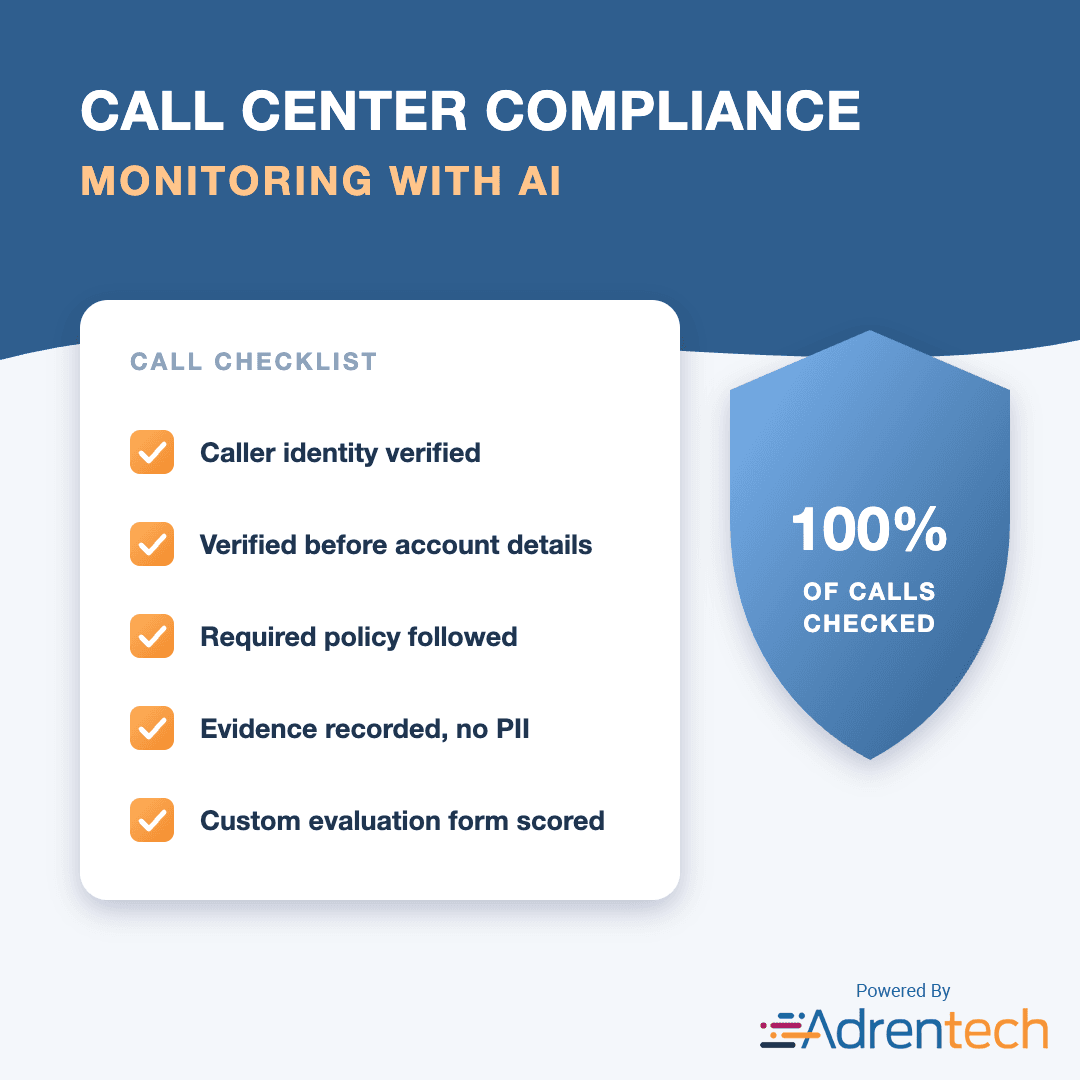
AI makes it possible to check every call. Adrentech Inform analyzes 100% of call recordings for identity verification outcomes, manual verification, caller types and policy adherence, and can score calls against your own compliance and quality evaluation forms with evidence from the transcript.
Table of Contents
- Key takeaways
- What is call center compliance monitoring?
- Why sampling is not enough
- Identity verification: what to check
- Policy adherence: what to measure
- How to set up automated compliance monitoring
- How Adrentech Inform automates compliance monitoring
- Compliance monitoring mistakes to avoid
- Frequently asked questions
- Check every call, not a sample
Key takeaways
- Compliance risk sits in the calls nobody reviews; sampling cannot find rare but serious failures.
- Identity verification is one of the most important and most measurable compliance steps.
- Compliance checks should record evidence of what happened, without repeating sensitive data.
- Policy adherence should be measured with the same rules for every agent and every call.
- Automated monitoring frees supervisors to coach instead of listening to random calls.
What is call center compliance monitoring?
Compliance monitoring is the ongoing review of customer interactions to confirm that agents follow legal, regulatory and internal requirements. Typical areas include:
| Area | Example requirement |
|---|---|
| Identity verification | Verify the caller before discussing or changing the account |
| Authorization | Confirm the caller is allowed to act on the account |
| Required disclosures | Explain terms, fees or conditions when required |
| Data handling | Do not repeat or record sensitive data unnecessarily |
| Company policy | Follow approved processes for credits, cancellations and exceptions |
| Conduct | Professional, respectful communication |
Which rules apply depends on your industry, region and internal policies.
Why sampling is not enough
A supervisor who reviews a few calls per agent per month sees a small fraction of total calls. This creates three problems:
- Rare failures are missed. A serious verification failure on one call in a hundred may never be sampled.
- Agent feedback is slow and narrow. Coaching is based on a handful of calls.
- Trends are invisible. You cannot tell whether compliance is improving or getting worse.
Analyzing every call solves all three.
Identity verification: what to check
Verification failures are one of the clearest compliance risks in a contact center, and one of the easiest to measure from a conversation.
| Check | Question |
|---|---|
| Verification outcome | Was the caller verified successfully, partially, or not at all? |
| Verification method | Was the caller pre-verified (for example in the phone menu) or verified manually by the agent? |
| Caller type | Was the caller the account holder, an authorized user, or a third party? |
| Timing | Was verification completed before account details were discussed? |
| Evidence | What did the agent ask for? (Recorded without the actual values) |
Recording evidence without values matters: a note such as "agent asked for the service address" proves the step happened without copying personal data into a report. Inform's AI is instructed to describe verification evidence this way.
Policy adherence: what to measure
- Policy adherence rate across calls, agents and teams.
- Adherence by call reason, because some call types carry more risk.
- Specific policy failures, so training targets the right rules.
- Related behavior, such as empathy and proactive solutions, for a fuller quality picture.
How to set up automated compliance monitoring
- Write down the rules. Define each requirement in clear, checkable terms.
- Turn rules into evaluation questions. For example: "Did the agent verify the caller before discussing account details?"
- Analyze every call. Apply the same questions to all calls automatically.
- Require evidence. Each answer should point to what was said in the call.
- Review exceptions. Supervisors focus on failed or unclear calls instead of random samples.
- Coach and trend. Use results for agent coaching and track compliance rates over time.
- Update the rules. When policies change, update the evaluation questions.
How Adrentech Inform automates compliance monitoring
Inform combines structured compliance fields with configurable, evidence-based evaluations.
- Verification outcomes recorded on every call.
- Manual verification and pre-verification detected, so you can see how callers were verified.
- Verification caller types, such as account holder or third party.
- Non-PII evidence notes that describe what was checked without including the values.
- Policy adherence, agent empathy and proactive solutions tracked across calls.
- Agent Interaction Reports (AIR) that score calls against your own compliance and quality forms, with transcript evidence and section-by-section verification.
- Sensitive data masking in transcripts, covering card numbers, security codes, expiry dates and Social Security numbers. See PII redaction in call transcripts.
- Team and workqueue access control, so supervisors see their own teams' calls.
- Scheduled reports that send compliance summaries by email.
Example questions you can ask Inform
- "What share of calls last month had a successful verification outcome?"
- "How many calls required manual verification, by workgroup?"
- "Which agents have the lowest policy adherence rate?"
- "Show policy adherence by call reason for the last quarter."
- "Show me calls where the caller was a third party."
Compliance monitoring mistakes to avoid
- Checking too few calls. Sampling hides rare but costly failures.
- Vague rules. If a rule cannot be checked consistently, it cannot be measured.
- No evidence. Agents and auditors need to see why a call passed or failed.
- Copying sensitive data into reports. Evidence should describe the check, not repeat the value.
- Using results only for discipline. Compliance data is most valuable as a coaching tool.
For a broader look at quality programs, read call center evaluation forms.
Frequently asked questions
What is call center compliance monitoring?
It is the ongoing review of customer calls to confirm that agents follow legal, regulatory and company requirements, such as verifying the caller's identity and following approved processes.
Can AI monitor compliance on every call?
Yes. AI call analysis can apply the same compliance checks to 100% of calls and record evidence for each result, which is not possible with manual sampling.
What is caller identity verification?
It is the process of confirming that the person on the phone is the account holder or an authorized user before discussing or changing the account.
How do you prove compliance without storing sensitive data?
Record evidence that describes the check, for example "agent asked for the date of birth", and mask the actual values in transcripts.
Does Adrentech Inform support custom compliance rules?
Yes. Inform's Agent Interaction Reports score calls against evaluation forms you define, so your own compliance questions can be applied to every call.
Does automated compliance monitoring replace supervisors?
No. It changes their focus. Supervisors spend less time listening to random calls and more time reviewing exceptions and coaching agents.
Check every call, not a sample
See verification and policy adherence across all of your calls. Book an Inform demo or contact the Adrentech team. For everything Inform extracts from a call, read AI call analysis software.
Share on social media


Call Transfer Analysis: How to Reduce Unnecessary Transfers in Your Contact Center