Multilingual vs Cross-lingual Capabilities in LLMs: A Comparative Analysis
Anita
June 24, 2025
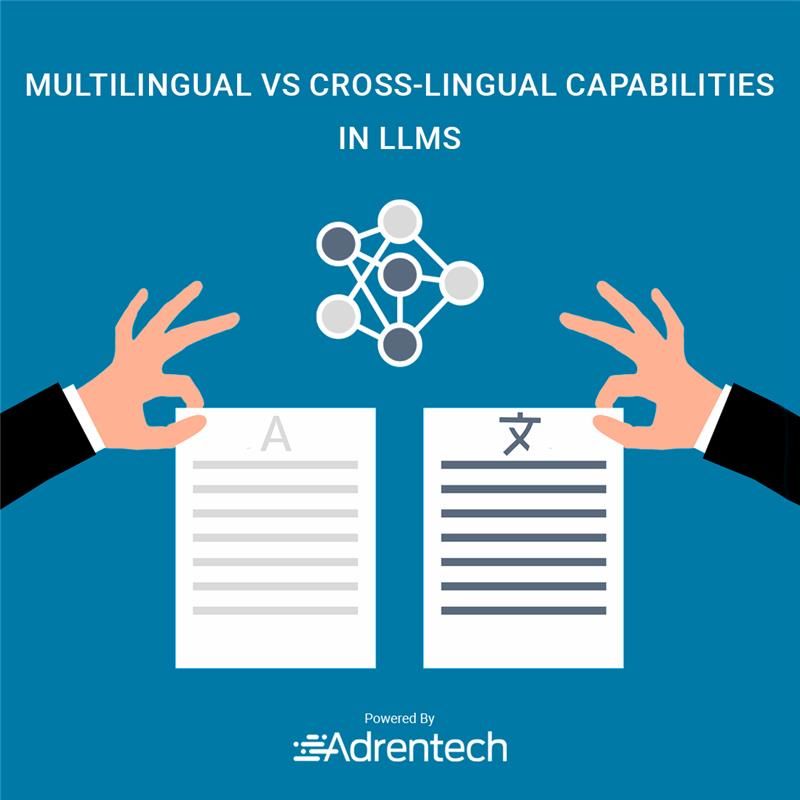
Multilingual vs Cross-lingual Capabilities in LLMs: A Comparative Analysis
Large language models (LLMs) are becoming increasingly pervasive across industries, from customer support to research assistance. However, to make these models truly accessible, it's crucial to reduce barriers — not just technical or financial, but linguistic as well. One key challenge is ensuring that LLMs can effectively serve users across diverse languages.
In this article, we’ll explore two related but distinct abilities that affect how LLMs handle multiple languages: multilingual and cross-lingual capabilities. These terms are often used interchangeably but refer to different competencies. Understanding their differences is essential for building inclusive and globally relevant AI systems. Do you want to leran more? Let's talk!
Table of Contents
- What does it mean for an LLM to be multilingual?
- How exactly are multilingual LLMs trained?
- What does it mean for an LLM to have cross-lingual capabilities?
- How exactly are cross-lingual LLMs trained?
- How do multilingual and cross-lingual capable LLMs intersect?
- How is the performance of multilingual vs cross-lingual capable models evaluated?
What does it mean for an LLM to be multilingual?
A multilingual LLM is designed to understand and generate text across multiple languages. To achieve this, it is trained on a wide-ranging, linguistically diverse dataset. This allows the model to handle inputs, generate outputs, and perform tasks in various languages.
For instance, a multilingual LLM can fluently answer questions in English, Spanish, Chinese, or French — provided it has seen sufficient training data in those languages.
How exactly are multilingual LLMs trained?
Training a multilingual LLM involves feeding it vast amounts of text data from different languages. Much of this data is typically scraped from the internet, where English still dominates. However, high-quality multilingual training requires intentional inclusion of diverse language sources.
Importantly, during training, the model often isn’t explicitly told which language it’s processing. Through self-supervised learning, it independently learns language structures, grammar, and vocabulary by detecting patterns and associations across the data.
What does it mean for an LLM to have cross-lingual capabilities?
A model with cross-lingual capabilities can apply knowledge gained in one language to tasks in another. This goes beyond simply understanding multiple languages — it enables transfer of knowledge across linguistic boundaries.
For example, a cross-lingual model might read medical research in English and accurately answer questions about it in Spanish, even if very little Spanish medical data was seen during training.
While cross-lingual ability requires multilingual competence as a foundation, it demands much deeper linguistic generalization.
How exactly are cross-lingual LLMs trained?
Cross-lingual capabilities emerge through enhanced training methods on top of multilingual training. Two common strategies include:
Retrieval-Augmented Generation (RAG): The model is connected to external knowledge bases, allowing it to fetch contextually relevant data across languages to aid understanding.
Mixed-language training: The model is exposed to datasets containing multiple languages within the same context. This forces the model to learn conceptual mappings between languages.
Unlike multilingual training, where performance is measured language-by-language, cross-lingual training focuses on evaluating the model’s ability to generalize knowledge across languages.
How do multilingual and cross-lingual capable LLMs intersect?
In short:
- All cross-lingual models are also multilingual.
- Not all multilingual models are cross-lingual.
Multilingualism is a prerequisite for cross-lingual performance, but achieving true cross-lingual understanding requires more advanced training and evaluation.
How is the performance of multilingual vs cross-lingual capable models evaluated?
Evaluating these capabilities requires more than checking whether the model “understands” each language. High-performing models must also:
- Generate accurate, safe, and contextually correct responses.
- Avoid introducing bias or factual errors due to imbalances in language representation.
- Demonstrate the ability to transfer knowledge across languages.
One major challenge is that most LLM training data still skews heavily towards English. Overcoming this imbalance is key to building models that can truly serve global users.
Conclusion
Understanding the differences between multilingual and cross-lingual capabilities is crucial for building globally inclusive language models. While these terms are closely related, they represent distinct technical goals:
- Multilingual models handle multiple languages independently.
- Cross-lingual models transfer knowledge between languages.
Share on social media


Modern WMS for Supply Chain - What We’ve Learned About Centralized Warehousing